World premiere at Hal4, Rotterdam on
16 march 1998
Dog (1998) '15
For
2 trumpet
2 horn in f
1 trombone
1 bass-trombone
Percussion 1 vibraphone, Tibetan bell, timpani 32″, tam-tam, China crash cymbal 20′
Percussion 2 turbular bells, marimba, hollow block, tom 12′, tom 13′, flor tom 16′, snare, bass drum
Percussion 3 chrotales 2 okt., gong, wind chimes from Ghana, splash cymbal, crash cymbal 16″, crash cymbal 17″
piano
Soloist grunt voice
2 violin
2 cello
2 contrabass
Andi Koening – trumpet
Koen Kaptijn – trombone
Mark Boonstra – bass-trombone
Wan kuk Kim – horn in f
Alle Lenoir – percussion
Dennis Geestman – grunt voice
Marcel Minderhoud – piano
Catharina Ungvari – violin
Estibalitz Galardi – violin
Sussana Guasch Melis – cello
Samuel Romani Lopez – cello
Lassi Hiltunen – contrabass
Igor Arjanovitch – contrabass
Pablo Fernando Varela – conductor
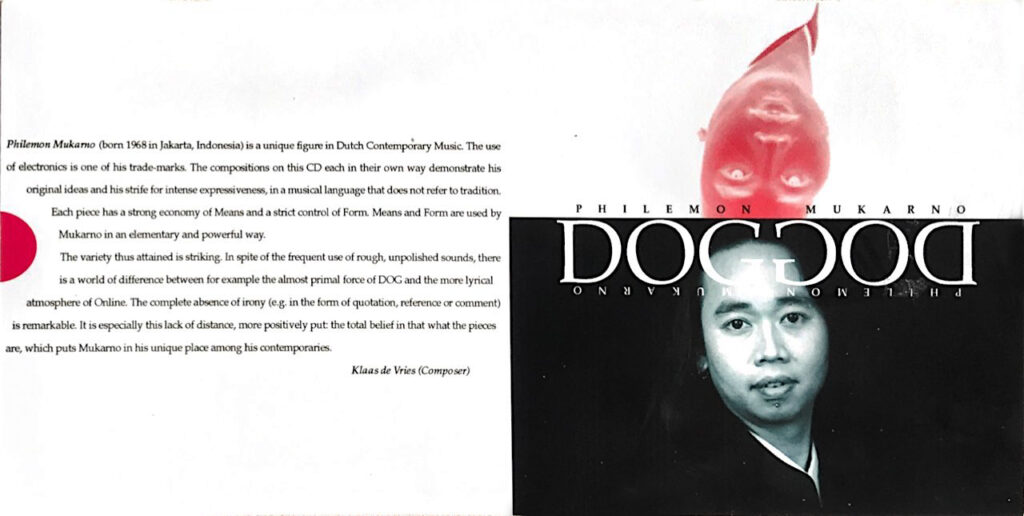
DOG: Philemon Mukarno’s Primal Scream of Structure and Beauty
The Birth of a Beast
On March 16, 1998, in the industrial cavern of Hal4 in Rotterdam, Philemon Mukarno unleashed a beast. The composition was titled simply, and brutally, DOG. Scored for a large ensemble and a soloist listed as a “grunt voice,” it was a declaration of war against musical politeness. DOG is not a piece that asks for permission. It kicks down the door. In the chronology of Mukarno’s work, this piece stands as a seminal moment—a “primal force” that defined his uncompromising aesthetic early in his career. It is a work where the refined world of the conservatory meets the raw aggression of the mosh pit.
The Grunt Voice: A Solitary Howl
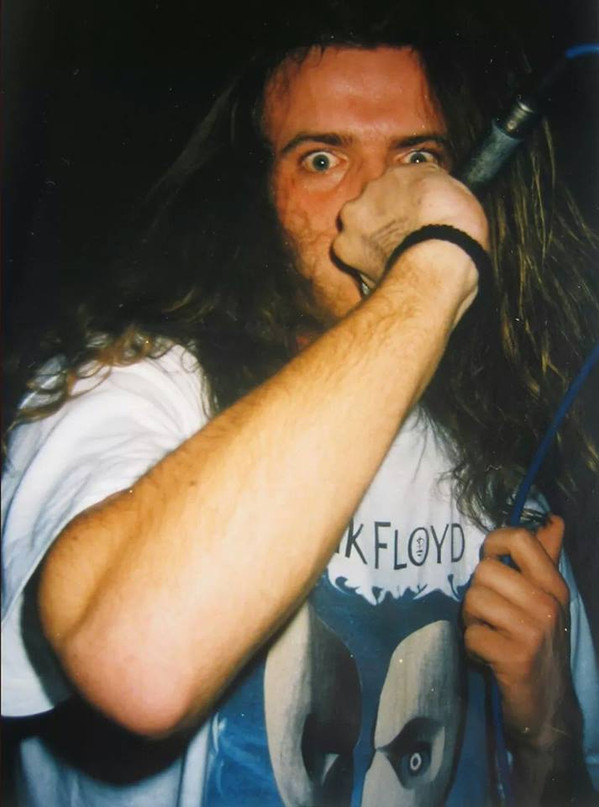
The most striking feature of DOG is its soloist. Mukarno does not call for a soprano or a baritone. He calls for a “grunt voice” (performed at the premiere by Dennis Geestman). This choice is radical. It strips the human voice of its lyrical pretensions and reduces it to its most animalistic element. The “grunt” is the sound of effort, of anger, of pure physical exertion. It is the voice before language. By placing this guttural sound at the center of a complex large ensemble work, Mukarno challenges the very hierarchy of Western art music. The soloist is not a hero singing an aria; he is a creature struggling to be heard against a wall of sound.
An Arsenal of Percussion
To support this primal voice, Mukarno assembles a percussion section that is essentially a weaponized orchestra. The instrumentation list is a catalogue of impact:
The Heavy Metal: Tam-tams, gongs, and massive cymbals (China crash 20’, crash 16’ and 17’) provide a metallic sheen that cuts through the air like a razor.
The Deep Earth: The 32-inch timpani and the bass drum create a subsonic rumble that shakes the floorboards.
The Ritualistic: Tibetan bells and wind chimes from Ghana introduce a spiritual, almost shamanic dimension, hinting at a ritual gone wrong.
The Driving Force: A full drum kit (toms, snare, bass drum) anchors the rhythm, giving the piece a propulsive, almost rock-like energy.
This percussion battery is not there for decoration. It creates a hostile environment. The three percussionists (Alle Lenoir, Lorena Gimeno, and a third player) are tasked with building a sonic cage for the rest of the ensemble.
The Brass Wall
The wind section of DOG is equally formidable. With two trumpets, two French horns, a trombone, and a bass trombone, Mukarno builds a wall of brass. This is not the warm, blended brass of a romantic symphony. It is jagged and aggressive. The players (including Andi Koening, Mark Kaptijn, Koen Kaptijn, Mark Boonstra, and Wan Kuk Kim) are pushed to their limits. They function as a single, breathing lung, exhaling blasts of sound that rival the percussion in intensity. The use of the bass trombone anchors the harmony in the mud, adding a growling low end that matches the grunt voice soloist.
Strings as Texture, Not Melody
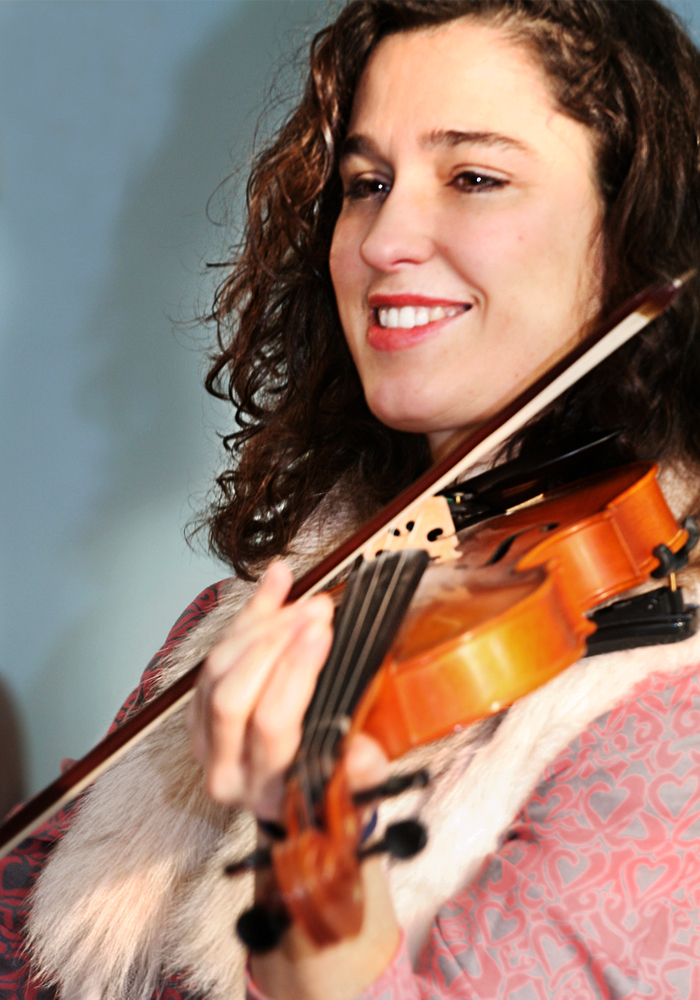
In a traditional concerto, the strings might provide a lush carpet for the soloist. In DOG, the strings (Catharina Ungvari, Estibalitz Galardi, Sussana Guasch Melis, Samuel Romani Lopez, Lassi Hiltunen, Igor Arjanovitch) are treated as textural generators. They scratch, slide, and attack. The inclusion of two double basses adds to the bottom-heavy weight of the piece. They grind against the cellos, creating a friction that is palpable. Mukarno uses the strings to add a layer of nervous energy, a constant tension that refuses to resolve.
Economy of Means, Control of Form
Despite the aggressive nature of the sound, DOG is not chaos. It is controlled chaos. Critics and analysts have noted the “profound economy of means” and “meticulous control of form” in the work. Mukarno does not waste energy. Every scream, every crash, and every silence is placed with surgical precision.
This is the paradox of Mukarno’s style: the sounds are “coarse and unpolished,” but the structure is crystalline. He treats the raw materials of noise with the rigorous discipline of a classical architect. The piece lasts for 15 minutes, a concise duration for such a dense work. There is no filler. It is a concentrated dose of intensity. The form likely follows a strict logic, perhaps a series of accumulating waves of tension that mirror the physical stamina of the “grunt” soloist.
The “Almost Primordial Force”
Comparing DOG to Mukarno’s other works reveals the breadth of his vision. As noted in program notes, there is a “world of difference” between the “almost primordial force of DOG” and the more “lyrical atmosphere of Online” (his violin solo work). Yet, both come from the same mind. DOG represents the earth element in his compositional chart—heavy, dirty, and undeniable. It is music that pulls you down into the mud.
This “primordial” quality is enhanced by the total “absence of irony.” Mukarno is not making fun of heavy metal or noise music. He is channeling their power. He believes in the “intrinsic essence” of the grunt and the crash. He presents them as valid, beautiful objects. This lack of detachment is what makes the piece so confronting. You cannot laugh it off. You have to face it.
The Conductor’s Challenge
Conducting DOG requires a leader who can manage extreme forces. Pablo Fernando Varela, who conducted the premiere, had to act as a lion tamer. Balancing a “grunt voice” against a battery of percussion and a wall of brass is a logistical nightmare. The conductor must ensure that the “meticulous form” remains intact even as the sounds threaten to tear the roof off. He must channel the aggression of the ensemble into a unified beam of energy.
A Ritual of the Underdog
The title DOG is evocative. It suggests an animalistic nature, loyalty, aggression, and perhaps a lowly status. Is the “grunt voice” the underdog, fighting against the machinery of the large ensemble? Or is the whole ensemble a pack of dogs, hunting a silent prey? Mukarno leaves this open to interpretation. But the visceral nature of the music suggests a struggle for survival. It is a ritual of the street, brought into the concert hall.
Conclusion: The Uncompromising Monolith
DOG (1998) remains one of Philemon Mukarno’s most defining statements. It is a manifesto of his uncompromising nature. By placing a “grunt voice” at the center of a serious composition, he challenged the definitions of beauty and virtuosity.
He proved that “rough, unpolished sounds” could be organized into a structure of profound meaning. DOG is a monolith of primal energy. It stands as a reminder that music does not always have to be pretty to be true. Sometimes, it just has to bark.
DOG showcases a profound economy of means and meticulous control of form. Mukarno adeptly employs these elements in a concise yet potent fashion. His compositions not only manifest his original concepts but also epitomize his relentless pursuit of intense expressiveness.
The resulting variety is truly striking. Despite the frequent integration of coarse and unpolished sounds, a clear distinction emerges between, for example, the almost primordial force of “DOG” and the more lyrical atmosphere of “Online.”
The conspicuous absence of irony, be it in the form of quotation, reference, or commentary, is particularly noteworthy. This deliberate lack of detachment accentuates Mukarno’s music, fostering an unwavering belief in the intrinsic essence of each piece, thereby distinguishing him in a truly unparalleled manner among his contemporaries.