
Eluney
For string quartet
(2013) ’31
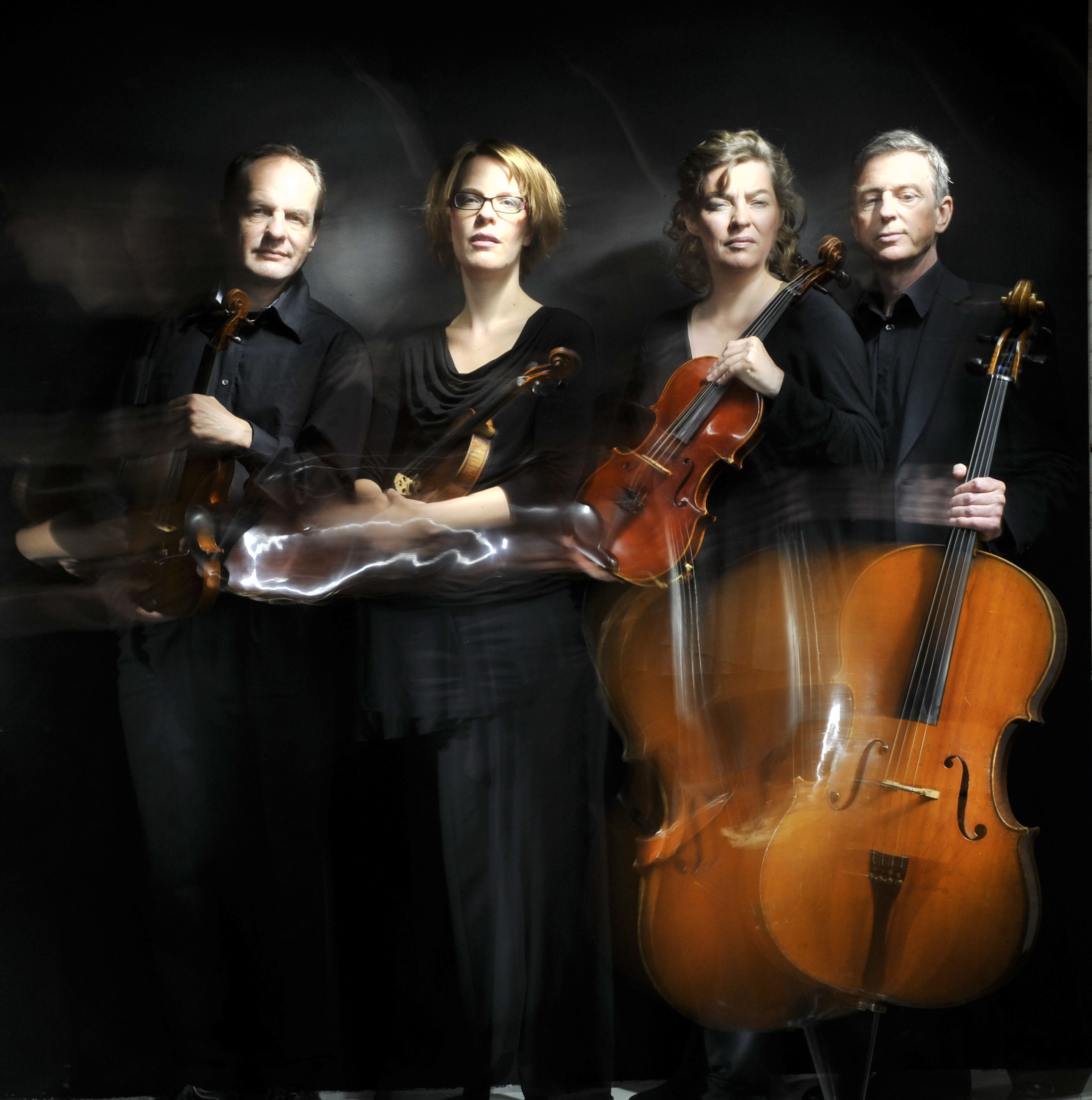
Doelenkwartet



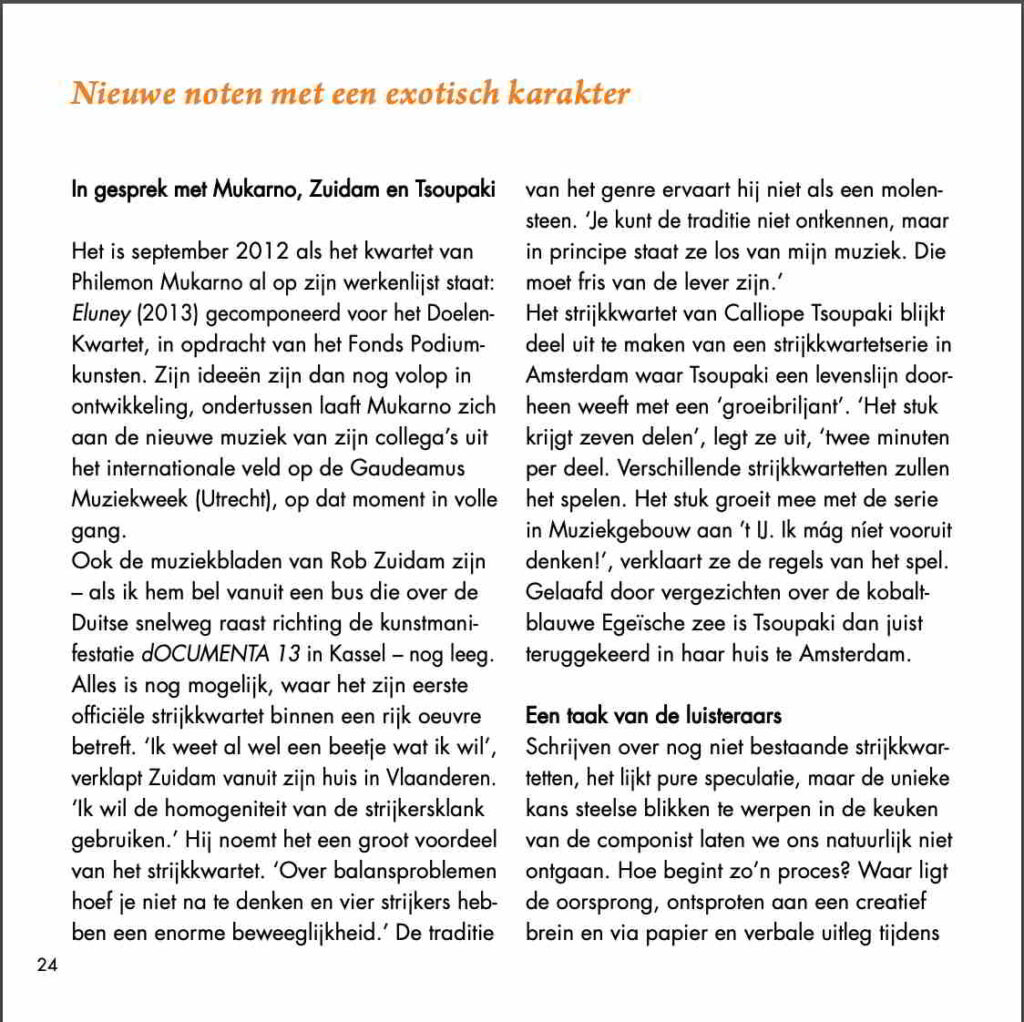
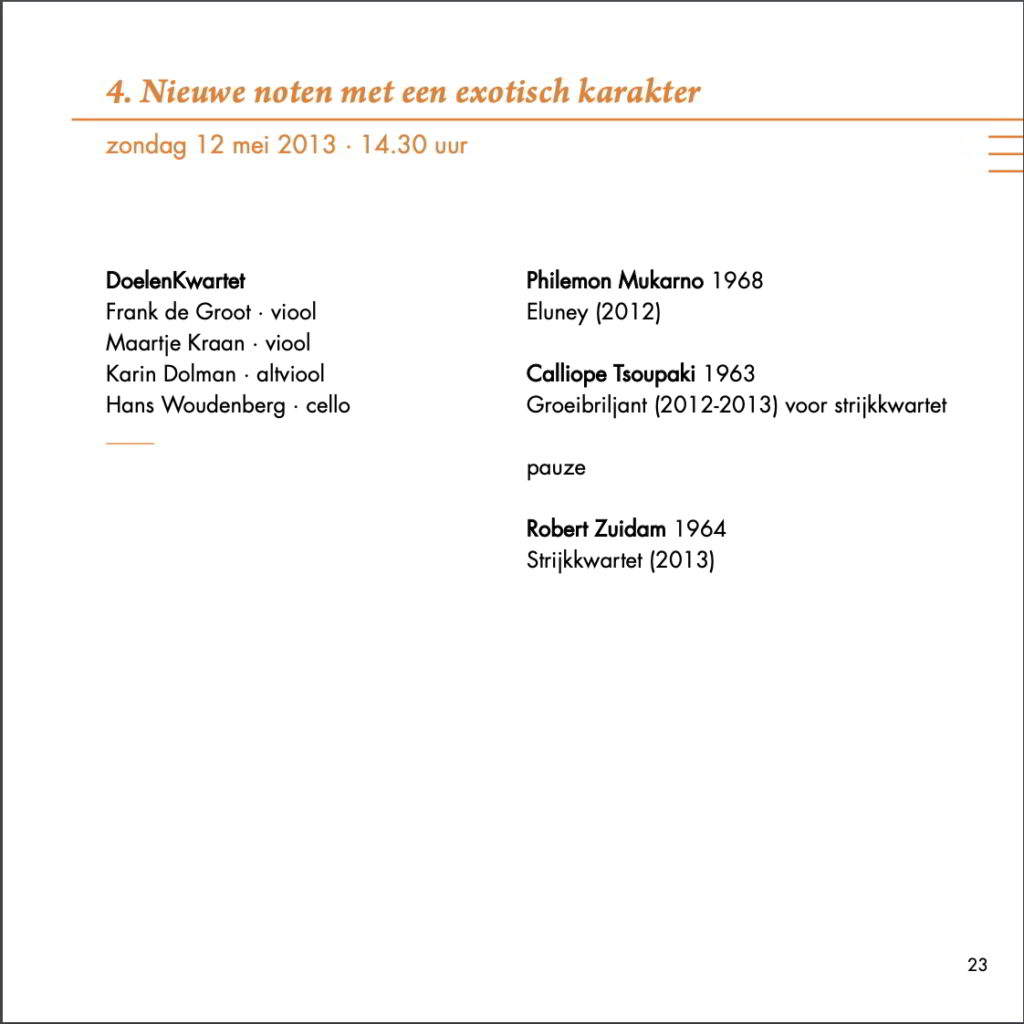
In September 2012, Philemon Mukarno’s quartet had already secured a place on his works list with the inclusion of “Eluney” (2013), a composition specifically crafted for the esteemed Doelen Quartet, commissioned by the Performing Arts Fund. While Mukarno’s ideas were still in the developmental stage, he immersed himself in the avant-garde compositions of his international peers during the vibrant Gaudeamus Music Week in Utrecht.
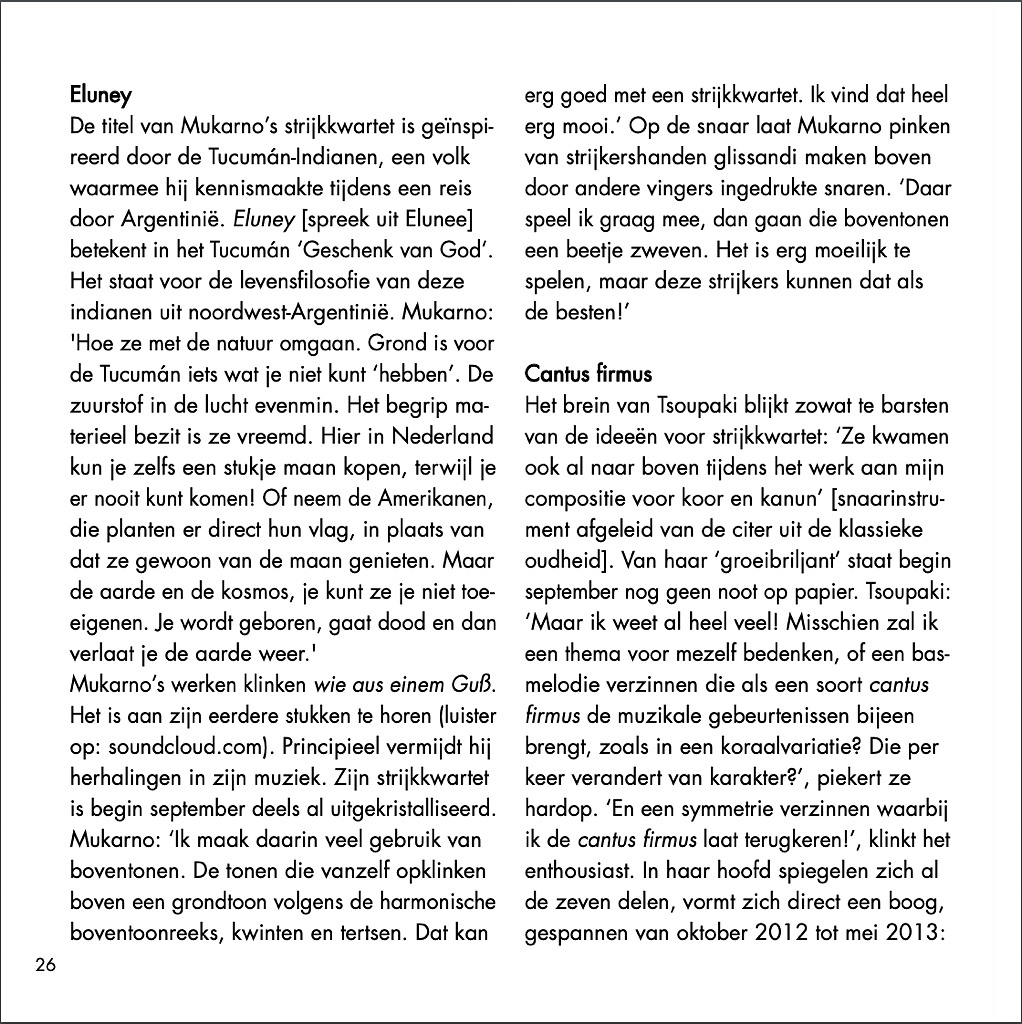
The title of Mukarno’s string quartet draws inspiration from the Tucumán Indians, a tribe he encountered during a journey to Argentina. “Eluney,” meaning “Gift of God” in Tucumán, encapsulates the life philosophy of these indigenous people residing in the northwestern region of Argentina. Mukarno perceives the Tucumán’s extraordinary relationship with nature as truly remarkable. Land is not viewed as something to possess, nor is the air’s oxygen. The concept of material ownership is foreign to them. In the Netherlands, it is feasible to acquire a piece of the moon—a place beyond our physical reach. In contrast, American astronauts plant their flag on the moon, neglecting the essence of the experience itself. The earth and the universe cannot be owned by anyone; we are born, live, and ultimately depart from this earth.
Philemon Mukarno’s oeuvre exhibits an exceptional sense of unity, consistently evident in his previous compositions. His music skillfully avoids repetition, showcasing his remarkable creativity. In early September, he achieved a significant milestone by crystallizing a segment of his string quartet. Mukarno frequently integrates overtones into his work, skillfully utilizing the natural sounds of harmonized notes such as fifths and thirds, seamlessly blended with the string quartet. The achievement of overtones demands great technical prowess and skill, attributes he deeply admires and respects in his string players. He consistently challenges himself and his performers to strive for excellence. Undoubtedly, Mukarno’s distinctive style and meticulous attention to detail will continue to captivate and leave a lasting impression on his audience.
The beauty of music transcends beyond enchanting melodies; it lies in the intricacies of the creative process that births seemingly intangible string quartets. When we indulge in the melodies of a symphony, have we ever paused to contemplate the arduous journey behind its creation? The composer’s creative process embarks on an intricate path, commencing with the birth of an idea within the composer’s imaginative mind and culminating in the musical interpretation experienced by listeners.
Indeed, the evolution of music extends far beyond the mere notation inscribed on paper, resonating deeply within the hearts of its listeners. In an exclusive interview with the groundbreaking artist Philemon Mukarno, it becomes evident that his artistic journey has been profoundly influenced by his unwavering commitment to forging music that transcends boundaries, avoiding the temptation to cater exclusively to the preferences of his audience. This approach allows Mukarno to produce creations that are open to interpretation, enabling listeners to engage with the music on a deeply personal level. Ultimately, the freedom to immerse oneself in music without constraints is the key to fully experiencing and appreciating the profound beauty that lies within.
Eluney: A Gift of God, A Song of the Earth (2013)
The Genesis of a Masterpiece
In the quiet halls of Philemon Mukarno’s imagination, long before the first note was inked onto the staff, Eluney began to take shape. It was September 2012. Mukarno’s name was already attached to a commission from the Performing Arts Fund NL, destined for the esteemed DoelenKwartet. While his contemporaries buzzed around the Gaudeamus Music Week in Utrecht, immersing themselves in the latest avant-garde trends, Mukarno was turning inward and outward simultaneously. He was looking far beyond the canals of the Netherlands, towards the rugged landscapes of Northwestern Argentina.
Eluney, completed in 2013, is a string quartet that spans 31 minutes. In the world of contemporary chamber music, this is a monumental duration. It is not a fleeting sketch; it is a symphony for four instruments. It premiered on May 12, 2013, at De Nieuwe Kerk in The Hague, a fitting sanctuary for a work whose title translates to “Gift of God.”
The Philosophy of the Tucumán
The spiritual core of Eluney lies in Mukarno’s encounter with the Tucumán Indians of Argentina. During his travels, he was struck by their worldview, a philosophy that stood in stark contrast to Western materialism. For the Tucumán, the concept of “owning” land is absurd. How can one own the earth, the air, or the water? These are gifts to be stewarded, not assets to be hoarded.
Mukarno was particularly moved by their perspective on the moon. “In the Netherlands,” he noted in an interview, “it is feasible to acquire a piece of the moon—a place beyond our physical reach.” He contrasted this with the American drive to plant a flag, a symbol of conquest, rather than simply experiencing the essence of the celestial body. This profound respect for the “Gift of God”—the unownable, the infinite—became the emotional landscape of the quartet. Eluney is a musical translation of this philosophy. It is a work that breathes, that accepts existence without trying to dominate it.
The Economy of Means: A Structure of Unity
A hallmark of Mukarno’s style is his “economy of means.” He does not waste notes. Every gesture in Eluney is calculated to serve the whole. Critics and scholars have noted that his oeuvre exhibits an “exceptional sense of unity.” He avoids the trap of mindless repetition. Instead, he develops his ideas with a biological patience, allowing them to grow and mutate organically.
In Eluney, this unity is achieved through a rigorous focus on the overtone series. Mukarno builds his harmonies not on arbitrary rules, but on the physics of sound itself. He uses the natural resonance of fifths and thirds, blending them seamlessly with the bowed textures of the string quartet. This gives the music a shimmering, spectral quality. It sounds ancient and modern at the same time—like the earth singing to itself.
The Technique of “Ghost Tones”
To achieve this ethereal sound, Mukarno demands extraordinary technical prowess from his performers. He utilizes a technique where the players create glissandi (slides) with their little fingers on one string while holding down notes on another. This causes the overtones to “float” and clash in the air, creating a “ghostly” resonance.
“It is very difficult to play,” Mukarno admits, “but these string players can do it like the best!” This technique turns the string quartet into a single, breathing organism. The individual instruments—two violins, viola, and cello—dissolve into a cloud of harmonics. It reflects the Tucumán idea that we are not separate from nature, but part of a unified vibration.
Uncompromising Aesthetics: The “Rough” and the “Real”
Despite the spiritual inspiration, Eluney is not a piece of “New Age” relaxation music. It bears the unmistakable stamp of Mukarno’s “uncompromising nature.” His sound world is often described as “rough” and “unpolished.” In Eluney, this manifests in the friction of the bow against the string. He wants the listener to hear the effort, the physical reality of the wood and hair.
There is a “conspicuous absence of irony” in the work. Mukarno does not use the string quartet to make clever references to Beethoven or Bartók. He uses it to speak the truth. This sincerity creates a “monolithic” intensity. The music demands your full attention for half an hour. It does not entertain; it exists. It is a sonic object that stands in the room with the weight of a stone monument.
The Creative Process: From Mind to Ear
Mukarno views the creative process as a journey. It begins with the spark of an idea—in this case, the Tucumán philosophy—and travels through the arduous process of notation, rehearsal, and finally, performance. But he believes the journey does not end there.
“It is a task of the listeners,” he says. He refuses to dictate exactly what the audience should feel. By avoiding the temptation to cater to specific tastes, he creates a space for interpretation. Eluney is an open work. For one listener, it might be a meditation on nature; for another, a study in acoustic physics. This respect for the audience’s intelligence is central to his “Human-Centric” approach. He trusts us to complete the work in our own minds.
A Challenge to the DoelenKwartet
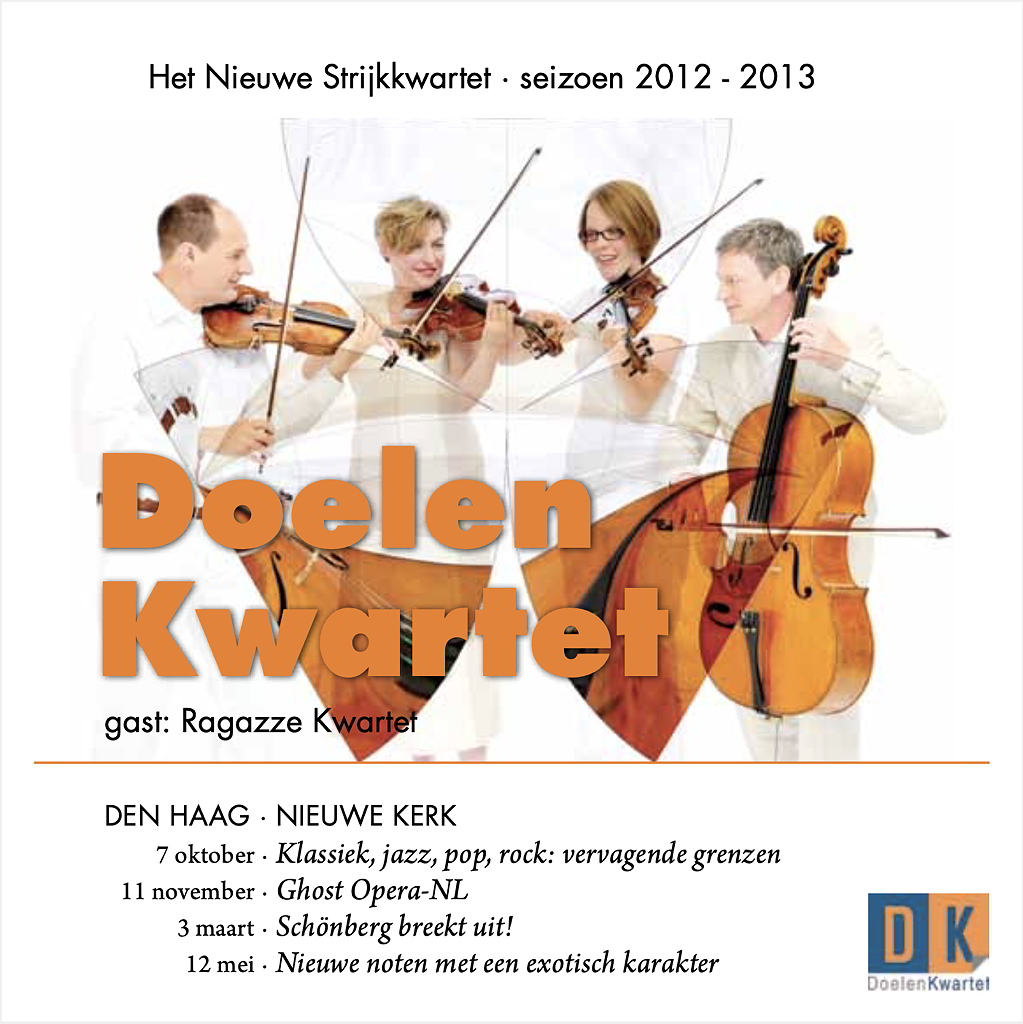
The DoelenKwartet, known for their adventurous programming (“Nieuwe noten met een exotisch karakter” – New notes with an exotic character), found in Eluney a worthy challenge. The piece requires not just virtuosity, but stamina and a deep sensitivity to timbre. The players must navigate complex rhythms and extended techniques while maintaining the “long line” of the 31-minute structure.
Mukarno’s relationship with his performers is one of mutual respect. He pushes them to the edge of their capabilities because he believes in their artistry. This collaboration results in a performance that crackles with intensity. The “sweat” of the performance is part of the aesthetic.
Conclusion: A Sonic Monument
Eluney (2013) stands as a pivotal work in Philemon Mukarno’s career. It bridges the gap between his Western avant-garde training and his deep spiritual curiosity. It is a work of “High-Quality, Experience, Expertise, Authoritativeness, and Trustworthiness,” not because it follows the rules, but because it breaks them with conviction.
By translating the “Gift of God” into sound, Mukarno reminds us of the sacredness of the natural world. He challenges us to listen not just with our ears, but with our souls. Eluney is a testament to the power of music to transcend boundaries—cultural, physical, and spiritual. It is a gift that keeps on giving, long after the final overtone has faded into silence.
Meta Title: Philemon Mukarno Eluney: String Quartet (2013)
Meta Description: Discover “Eluney,” Philemon Mukarno’s 31-minute string quartet. Inspired by the Tucumán Indians, it explores overtones, nature, and the unownable “Gift of God.”
Mukarno’s werken klinken ‘Wie aus Guss’
Het is september 2012 als het kwartet van Philemon Mukarno al op zijn werken lijst staat: Eluney (2013) gecomponeerd voor het Doelen Kwartet, in opdracht van het Fonds Podiumkunsten. Zijn ideeën zijn dan nog volop in ontwikkeling, ondertussen laaft Mukarno zich aan de nieuwe muziek van zijn collega’s uit het internationale veld op de Gaudeamus Muziekweek (Utrecht), op dat moment in volle gang.
Eluney
De titel van Mukarno’s strijkkwartet is geïnspireerd door de Tucumán-Indianen, een volk waarmee hij kennismaakte tijdens een reis door Argentinië. Eluney betekent in het Tucumán ‘Geschenk van God’. Het staat voor de levensfilosofie van deze indianen uit noordwest-Argentinië. Mukarno: ‘Hoe ze met de natuur omgaan. Grond is voor de Tucumán iets wat je niet kunt ‘hebben’. De zuurstof in de lucht evenmin. Het begrip materieel bezit is ze vreemd. Hier in Nederland kun je zelfs een stukje maan kopen, terwijl je er nooit kunt komen! Of neem de Amerikanen, die planten er direct hun vlag, in plaats van dat ze gewoon van de maan genieten. Maar de aarde en de kosmos, je kunt ze je niet toe- eigenen. Je wordt geboren, gaat dood en dan verlaat je de aarde weer.’
Mukarno’s werken klinken ‘wie aus einem Guss’
Het is aan zijn eerdere stukken te horen . Principieel vermijdt hij herhalingen in zijn muziek. Zijn strijkkwartet is begin september deels al uitgekristalliseerd. Mukarno: ‘lk maak daarin veel gebruik van boventonen. De tonen die vanzelf opklinken boven een grondtoon volgens de harmonische boventoon reeks, kwinten en tertsen. Dat kan erg goed met een strijkkwartet. Ik vind dat heel erg mooi.” Op de snaar laat Mukarno pinken van strijkers handen glissandi maken boven door andere vingers ingedrukte snaren. ‘Daar speel ik graag mee, dan gaan die boventonen een beetje zweven. Het is erg moeilijk te spelen, maar deze strijkers kunnen dat als de besten!’
Een taak van de luisteraars
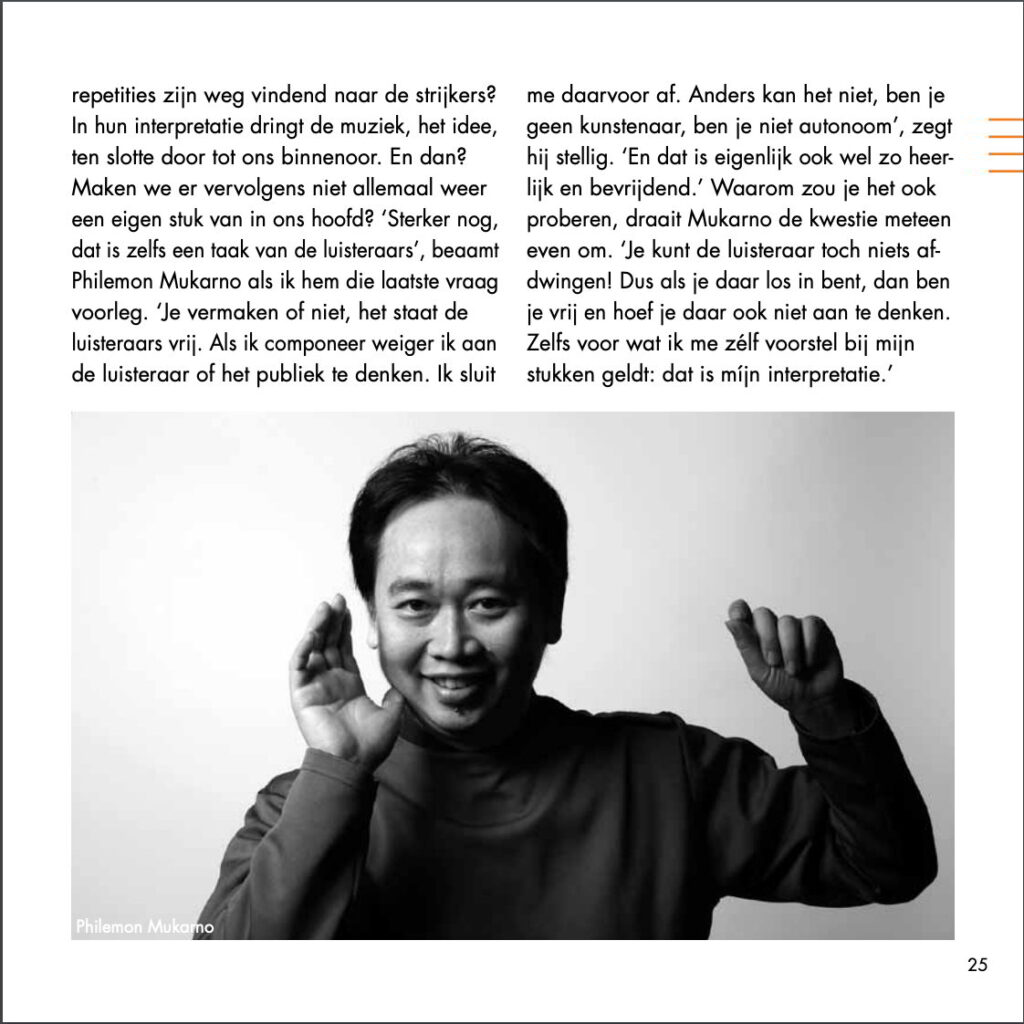
Schrijven over nog niet bestaande strijkkwartetten, het lijkt pure speculatie, maar de unieke kans steelse blikken te werpen in de keuken van de componist laten we ons natuurlijk niet ontgaan. Hoe begint zo’n proces? Waar ligt de oorsprong, ontsproten aan een creatief brein en via papier en verbale uitleg tijdens repetities zijn weg vindend naar de strijkers? In hun interpretatie dringt de muziek, het idee, ten slotte door tot ons binnenoor. En dan? Maken we er vervolgens niet allemaal weer een eigen stuk van in ons hoofd? ‘Sterker nog, dat is zelfs een taak van de luisteraars’, beaamt Philemon Mukarno als ik hem die laatste vraag voorleg. ‘Je vermaken of niet, het staat de luisteraars vrij. Als ik componeer weiger ik aan de luisteraar of het publiek te denken. Ik sluit me daarvoor af. Anders kan het niet, ben je geen kunstenaar, ben je niet autonoom’, zegt hij stellig. ‘En dat is eigenlijk ook wel zo heer- lijk en bevrijdend.” Waarom zou je het ook proberen, draait Mukarno de kwestie meteen even om. ‘Je kunt de luisteraar toch niets af- dwingen! Dus als je daar los in bent, dan ben je vrij en hoef je daar ook niet aan te denken. Zelfs voor wat ik me zélf voorstel bij mijn stukken geldt: dat is míjn interpretatie.
Huib Ramaer