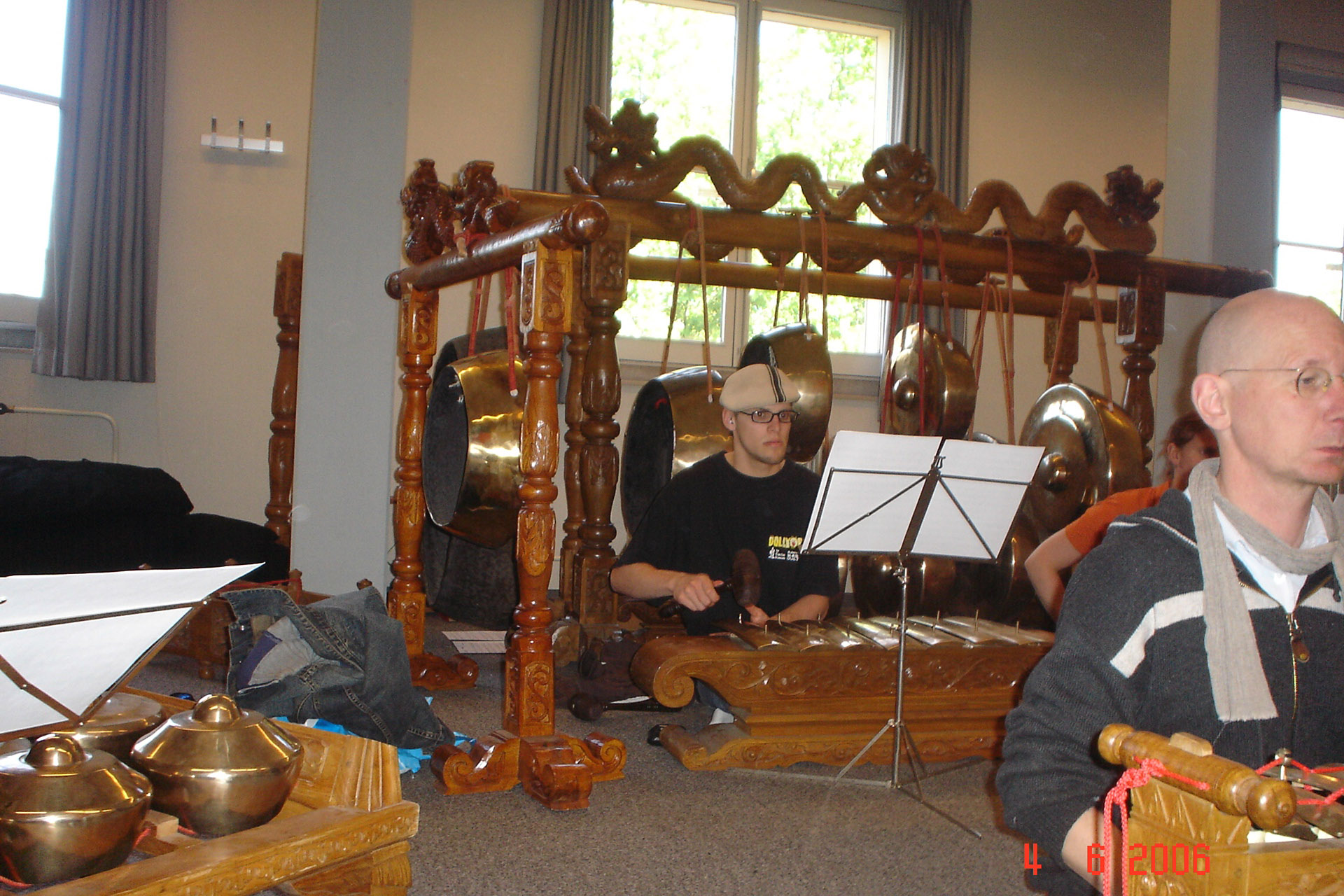
Malaikat (2006) - Ensemble Gending
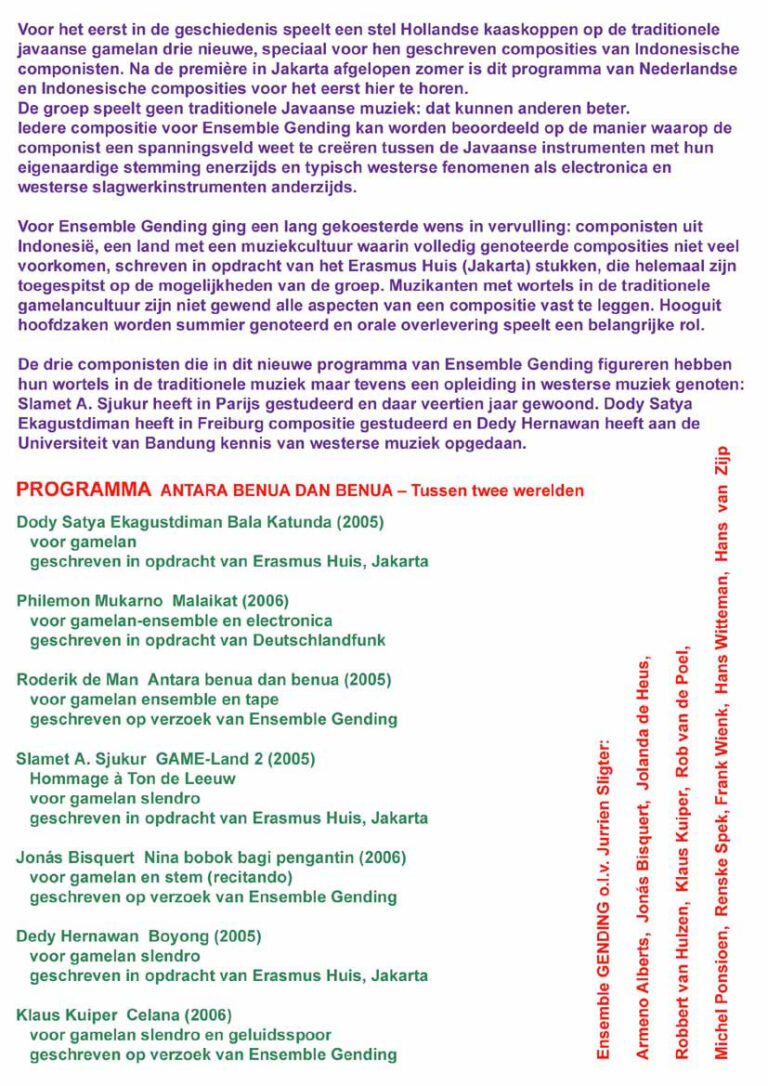
- ROBBERT VAN HULZEN
- HANS VAN ZIJP
- JONÁS BISQUERT
- RENSKE SPEK
- FRANK WIEK
- ROB VAN DE POEL
- KLAUS KUIPER

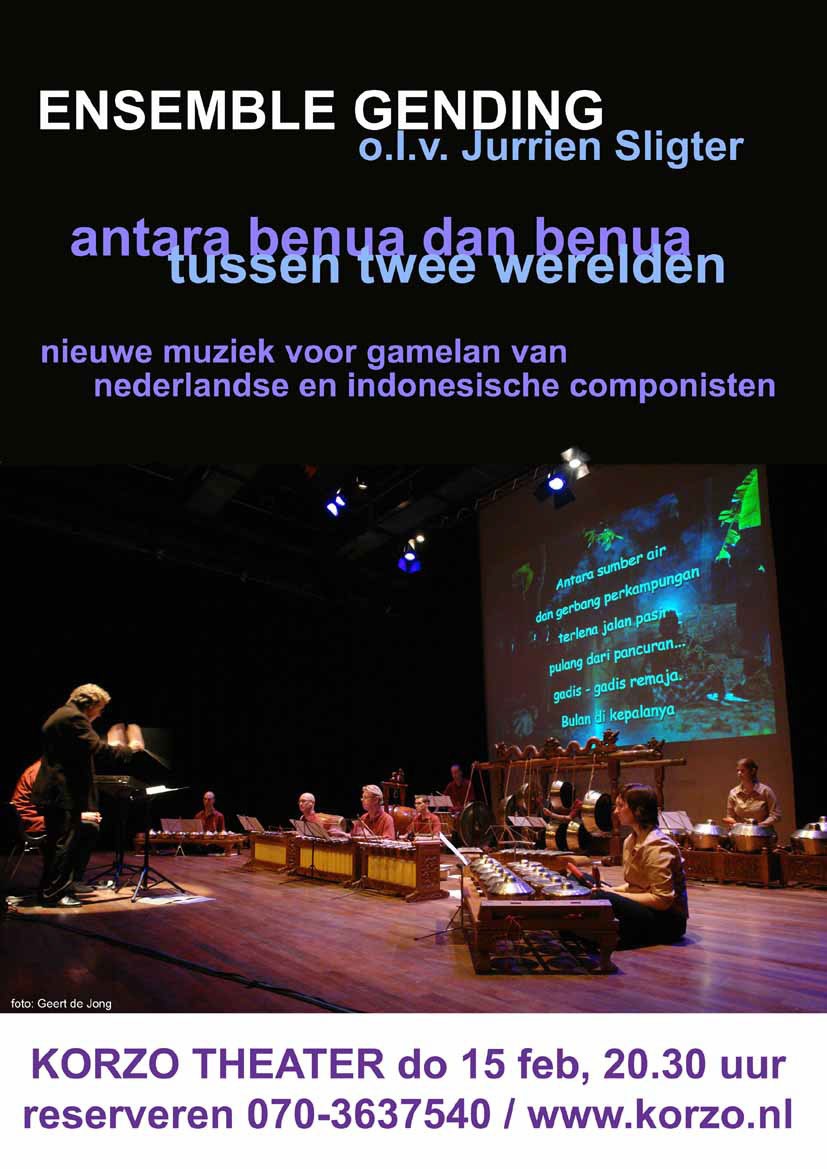
Composed on request of Gending Ensemble. Commissioned by Deutschlandfunk.
Malaikat: Philemon Mukarno’s Monolith of Bronze and Spirit
The Architecture of the Invisible
In the vast and varied catalogue of Philemon Mukarno, the composition Malaikat (2006) stands as a towering monolith. Scored for a full Slendro Gamelan ensemble, this twenty-minute work is a profound exploration of acoustic power. It is a piece that refuses to compromise. It does not seek to please with exotic melodies or soothing atmospheres. Instead, it confronts the listener with the raw, terrifying reality of sound itself. To understand Malaikat is to understand the essence of Mukarno’s artistic philosophy: a belief in the physical weight of music and the spiritual necessity of truth.
Unlike many of his other celebrated works, such as Jagat or Taric, Malaikat does not rely on electronics to expand its sonic palette. There are no digital delays, no synthesized textures, and no “voice-skins” to hide behind. Here, Mukarno faces the ancient bronze instruments of the Javanese Gamelan alone. He strips them of their traditional cultural associations and treats them as pure sources of vibration. The result is a work of “acoustic futurism”—music that uses centuries-old technology to create a sound that feels utterly alien and startlingly new.
The Name: Angels of Terror and Truth
The title, Malaikat, translates from Indonesian and Malay as “Angel.” However, one must strip away the Westernized, Romantic image of the angel as a gentle, winged cherub playing a harp. In the Semitic and Islamic traditions—and indeed in the deeper, pre-modern Christian understanding—an angel (Malaikat/Mal’akh) is a being of terrifying power. They are messengers of the Absolute, beings of fire and light who command awe and fear. When an angel appears in ancient texts, the first words are often “Do not be afraid,” precisely because their presence is overwhelming.
Mukarno’s Malaikat embodies this definition. The music is not gentle. It is a force of nature. It descends upon the listener with the weight of judgment. The “uncompromising nature” that critics so often praise in Mukarno’s work finds its perfect subject here. An angel does not negotiate; it delivers a message. Similarly, this composition does not bargain with the audience’s expectations. It unfolds with a stern, inevitable logic. The “complete absence of irony” that characterizes Mukarno’s style is crucial here. To write a piece about angels in 2006 without a hint of cynicism or kitsch is a radical act. It requires a belief in the subject matter that is rare in contemporary art. Mukarno presents the “Malaikat” not as a metaphor, but as a sonic reality.
The Instrument as Architecture
The work was composed at the request of Ensemble Gending, a Dutch-based group dedicated to performing new music on the Javanese Gamelan. This context is vital. Ensemble Gending’s mission aligns perfectly with Mukarno’s vision: to liberate the Gamelan from the museum of “world music” and treat it as a contemporary instrument.
The instrumentation for Malaikat utilizes the full spectrum of the Slendro Gamelan. The Slendro scale, a five-tone tuning system with roughly equidistant intervals, provides a specific harmonic color that is distinct from the Western chromatic scale. Mukarno, however, does not use Slendro to evoke a sense of “Javanese-ness.” He uses it to construct a closed harmonic universe.
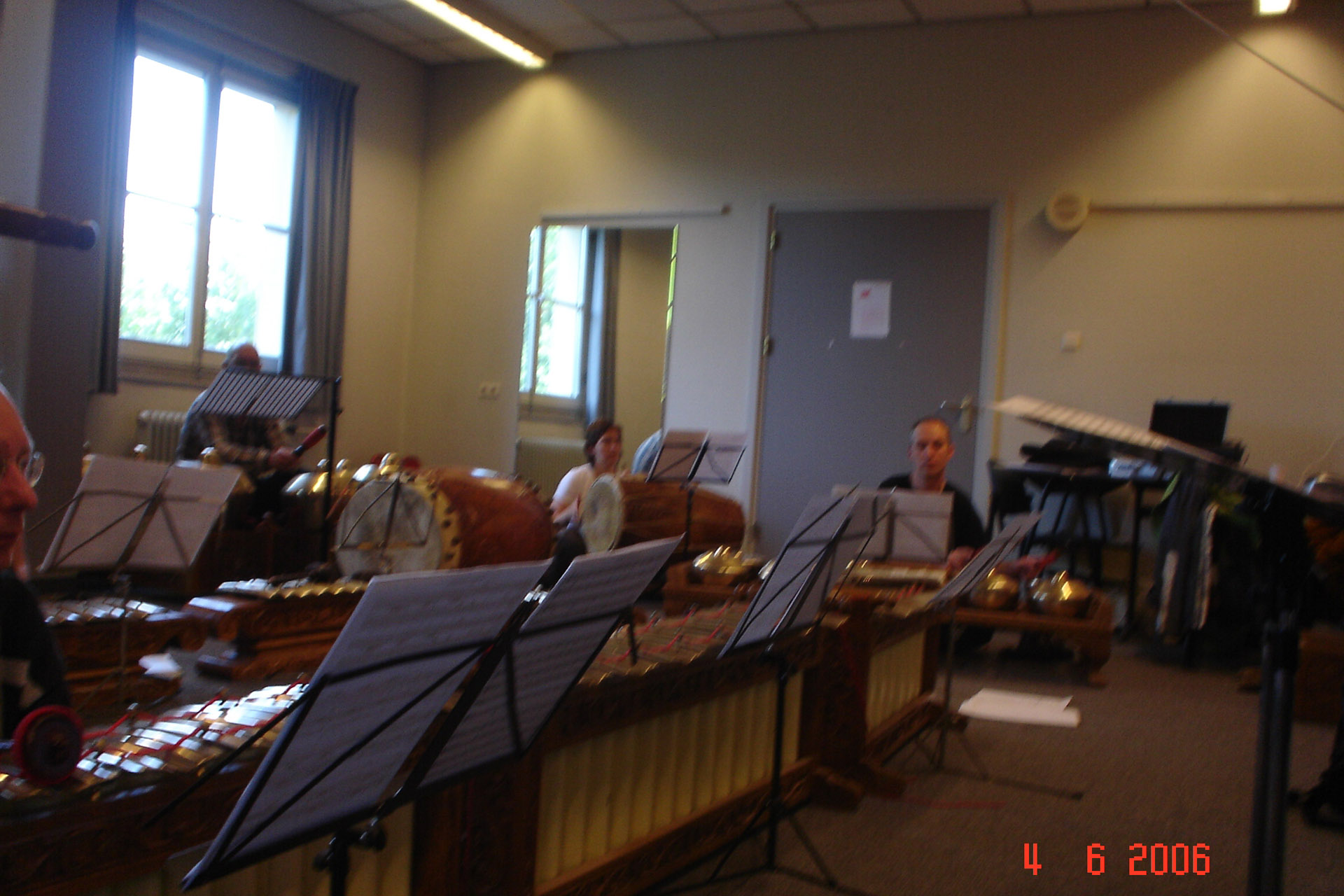
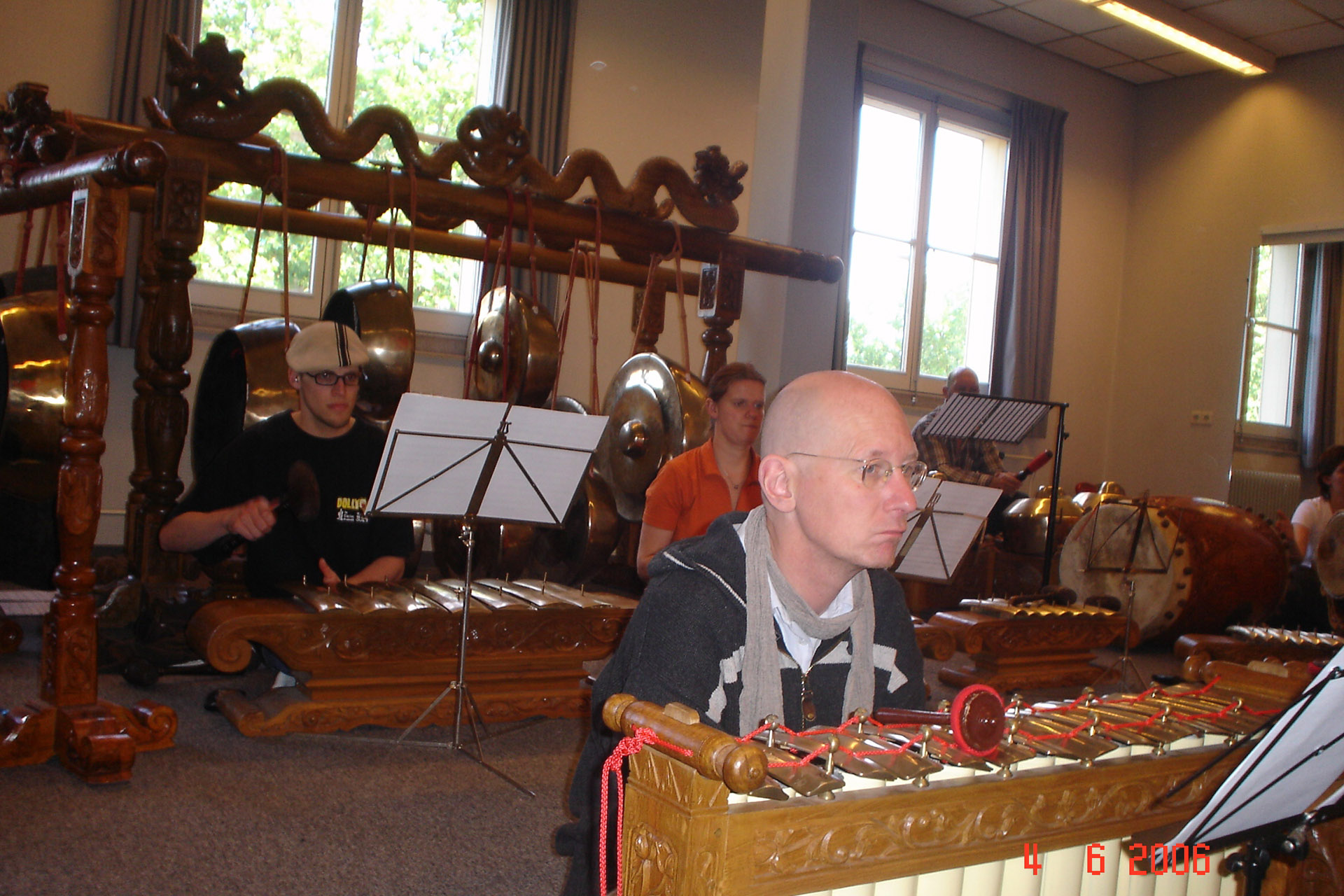
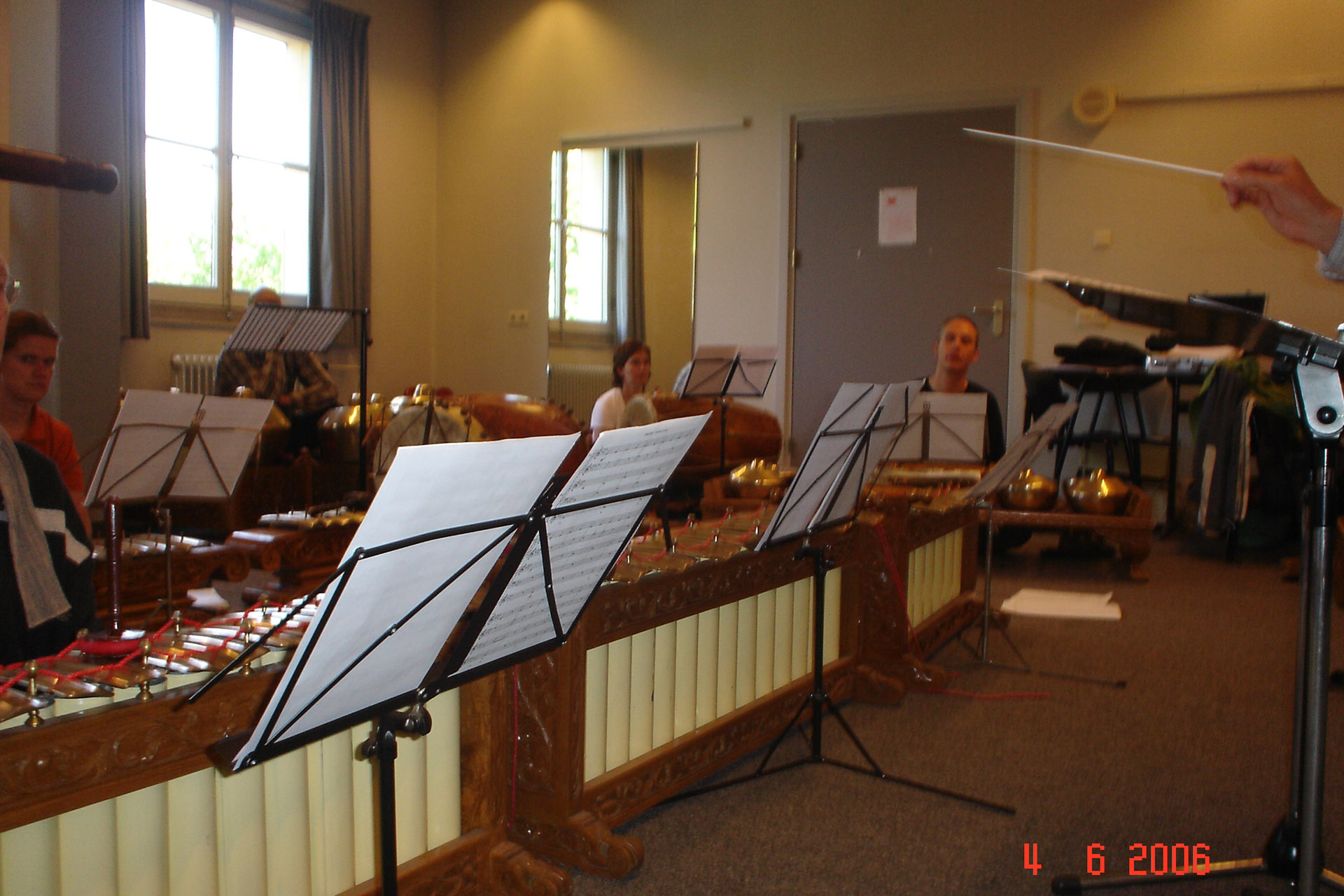
The ensemble list is exhaustive:
The Saron Family (Peking, Barung, Demung): These metallophones provide the hard, bright skeletal structure of the sound. In traditional Karawitan, they carry the melody. In Malaikat, they often act as rhythmic hammers, striking with a brutality that emphasizes the hardness of the bronze.
The Gender Family (Panerus, Barung, Slentem): These instruments, with their tube resonators, usually offer a shimmering, sustained layer. Mukarno recontextualizes them, perhaps focusing on their ability to create complex, interlocking resonance patterns that blur the perception of time.
The Bonang Family (Panerus, Barung): The gongs-chimes that usually embellish the melody are treated here as textural generators. Their piercing attack cuts through the dense air of the composition.
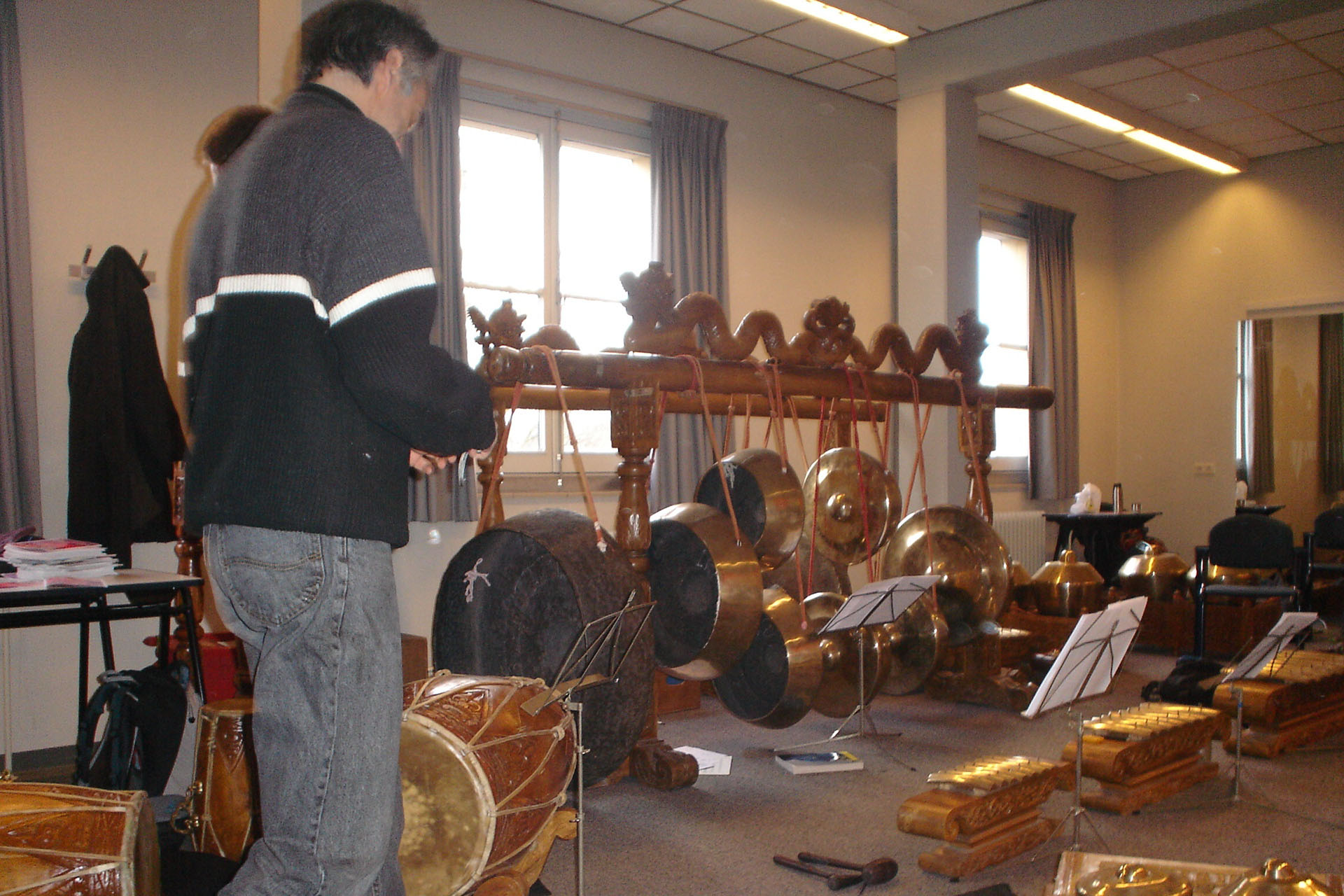
The Gongs (Kempul, Sluwukan, Ageng): The soul of the Gamelan. The great Gong Ageng marks the end of cycles in traditional music. In Mukarno’s hands, the Gong becomes a portal to the abyss. Its low frequency is felt in the stomach rather than heard by the ears. It anchors the “monolithic” structure of the piece.
Percussion and Strings (Kendang drums, Bedug, Rebab, Cengceng): The drums (Kendang) and the massive Bedug (often used in mosques) provide the visceral pulse. The Rebab (spike fiddle) offers a lonely, piercing line that contrasts with the heavy metal.
Mukarno treats this orchestra not as a collection of separate voices, but as a single, giant machine. The “Economy of Means” he is famous for is at work here. He does not let everyone play all the time. He carves out massive blocks of sound, juxtaposing the high, piercing cry of the Saron Peking against the subterranean rumble of the Gong Ageng.
Acoustic Futurism: The “Rough” Aesthetic
A defining characteristic of Mukarno’s style is his preference for “rough” or “unpolished” sounds. He is not interested in the polite, blended sound of a Western symphony orchestra. He wants the grain. He wants the friction.
In Malaikat, this aesthetic is pushed to the forefront. The listener hears the wood of the mallets hitting the bronze. You hear the decay of the note, the way the sound wobbles and beats as it fades. By refusing to smooth over these physical details, Mukarno creates a sound that is incredibly tactile. It feels as though the listener is inside the instrument itself.
This approach creates a paradox: Acoustic Futurism. By focusing on the raw physics of sound—the clashing overtones, the metallic attack, the complex decay—Mukarno makes these ancient instruments sound like synthesizers. The complex inharmonic spectra of the Gamelan bells, when played with his specific modern techniques, resemble the ring modulation and frequency shifting of electronic music. Yet, it is all acoustic. It is a “sci-fi” soundscape generated entirely by human muscle and bronze. This proves that “modernity” is not about using computers; it is about how you listen to and organize sound.
The Structure of Time: Twenty Minutes of Eternity
The duration of Malaikat—twenty minutes—is significant. In the world of new music, time is a canvas. Twenty minutes is long enough to lose one’s sense of self. It is long enough to enter a trance state.
Mukarno’s approach to time is architectural. He builds the piece in sections that feel like rooms in a vast temple. The music does not necessarily “develop” in the linear, Western sense of a narrative journey. Instead, it “rotates.” It examines an object from different angles.
Silence plays a crucial role in this architecture. Mukarno is a sculptor of silence. In Malaikat, the pauses are as heavy as the notes. When the Gamelan stops, the room is filled with the “ghost” of the sound—the ringing in the listener’s ears. This use of negative space creates immense tension. It forces the audience to wait, to breathe, and to confront the void. This silence is the domain of the Angel. It is the silence of the sacred, which is terrified of speaking falsely.
The rhythmic structure likely draws on the additive rhythms and complex cycles of the Gamelan but fractures them. Instead of the smooth, flowing cycles of traditional Gending, Mukarno introduces jagged edges. The rhythm might stumble, halt, or explode into chaos before finding a new order. This reflects the “uncompromising” nature of the Angel—it disturbs the natural order to bring a higher truth.
The Commission: A Stage for the Avant-Garde
Malaikat was commissioned by Deutschlandfunk (German National Radio), a major institution in the European avant-garde scene. This commission highlights Mukarno’s standing in the international contemporary music world. It premiered on March 19, 2006, in Cologne, Germany.
The premiere in Germany is symbolic. Germany has a long tradition of serious, structuralist music (Stockhausen, Lachenmann). Mukarno’s work, with its rigor and structural integrity, fits well within this context. Yet, the Indonesian instrumentation disrupts the Eurocentric narrative. He brings the East to the West, not as a souvenir, but as a challenge. He says, “This instrument, this Gamelan, is capable of the same intellectual and structural depth as your orchestras.”
For Ensemble Gending, this piece represented a challenge. The musicians, trained in both traditional and contemporary techniques, had to execute Mukarno’s demanding score. The “roughness” he demands is often harder to achieve than perfection. It requires a controlled chaos. It requires the musicians to unlearn the “polite” way of playing and rediscover the primal energy of the instrument.
Comparative Aesthetics: Malaikat vs. Taric
To fully appreciate Malaikat, it is helpful to compare it to Mukarno’s other major Gamelan work, Taric (2000).
Taric is scored for Slendro Gamelan and live electronics. In that piece, the electronics act as a shadow, extending the acoustic sound into infinite space. It is a dialogue between the old and the new technology.
Malaikat, written six years later, removes the electronics. This suggests a maturation, a “return to the source.” It is as if Mukarno realized he no longer needed the electronics to achieve the futuristic, monolithic sound he desired. He could find it within the bronze itself.
This stripping away of the electronic layer makes Malaikat a more vulnerable, yet more confident work. It relies entirely on the composition—the notes on the page and the energy of the players. It is a “naked” work. And like the biblical angels, its nakedness is its power.
The Physicality of the Performance
A performance of Malaikat is a physical spectacle. The Gamelan is not a set of small instruments; it is a collection of heavy objects. The large gongs must be struck with full-body weight. The Saron players hammer metal keys with wooden mallets.
Mukarno’s writing emphasizes this physicality. The score likely demands extreme dynamics, forcing the players to push the instruments to their limits. The “Bedug” drum, often used to call people to prayer, requires a massive physical effort to play. By foregrounding this exertion, Mukarno reminds the audience that sound is energy. It is work. It is struggle.
This physicality connects to his broader interest in multimedia and dance. Even though Malaikat is a concert piece, it moves like a dancer. It has weight, momentum, and stillness. One can easily imagine it as the score for a heavy, slow-moving choreography—perhaps a dance of stone statues coming to life.
The Spiritual Dimension: Sound as Ritual
While Mukarno is a contemporary composer, the shadow of the Javanese court ritual hangs over his work. Traditional Gamelan music is functional; it accompanies shadow plays (Wayang), dances, and royal ceremonies. It is designed to connect the human realm with the spiritual realm.
Malaikat retains this ritualistic function but changes the deity. It is not a ritual for the Javanese court; it is a ritual for the modern condition. It is a ceremony of concentration. In a world of distraction, Mukarno asks us to sit for twenty minutes and listen to the truth of bronze.
The “Malaikat” or Angel is the intermediary. The music acts as a bridge. The low frequencies of the gongs ground us in the earth, while the high, shimmering frequencies of the overtone-rich metallophones pull us upward. The piece exists in the tension between these two poles: gravity and flight, earth and sky, human and angel.
An Enduring Masterpiece
Malaikat (2006) is more than just a composition for Gamelan; it is a manifesto of Philemon Mukarno’s artistic identity. It showcases his refusal to compromise, his distinct sense of “rough” aesthetics, and his ability to create monolithic structures of sound.
By stripping the Gamelan of both traditional clichés and electronic enhancements, he reveals the instrument’s true, raw power. He creates a work that is timeless—it sounds ancient and futuristic simultaneously. It is a piece that demands respect. It stands in the concert hall like a dark, heavy stone, vibrating with a secret energy.
For the listener, Malaikat is an experience of confrontation. We are confronted by the power of the sound, by the vastness of the silence, and by the terrifying sincerity of the composer’s vision. In an age of disposable culture, Philemon Mukarno offers us something permanent. He offers us the Angel.
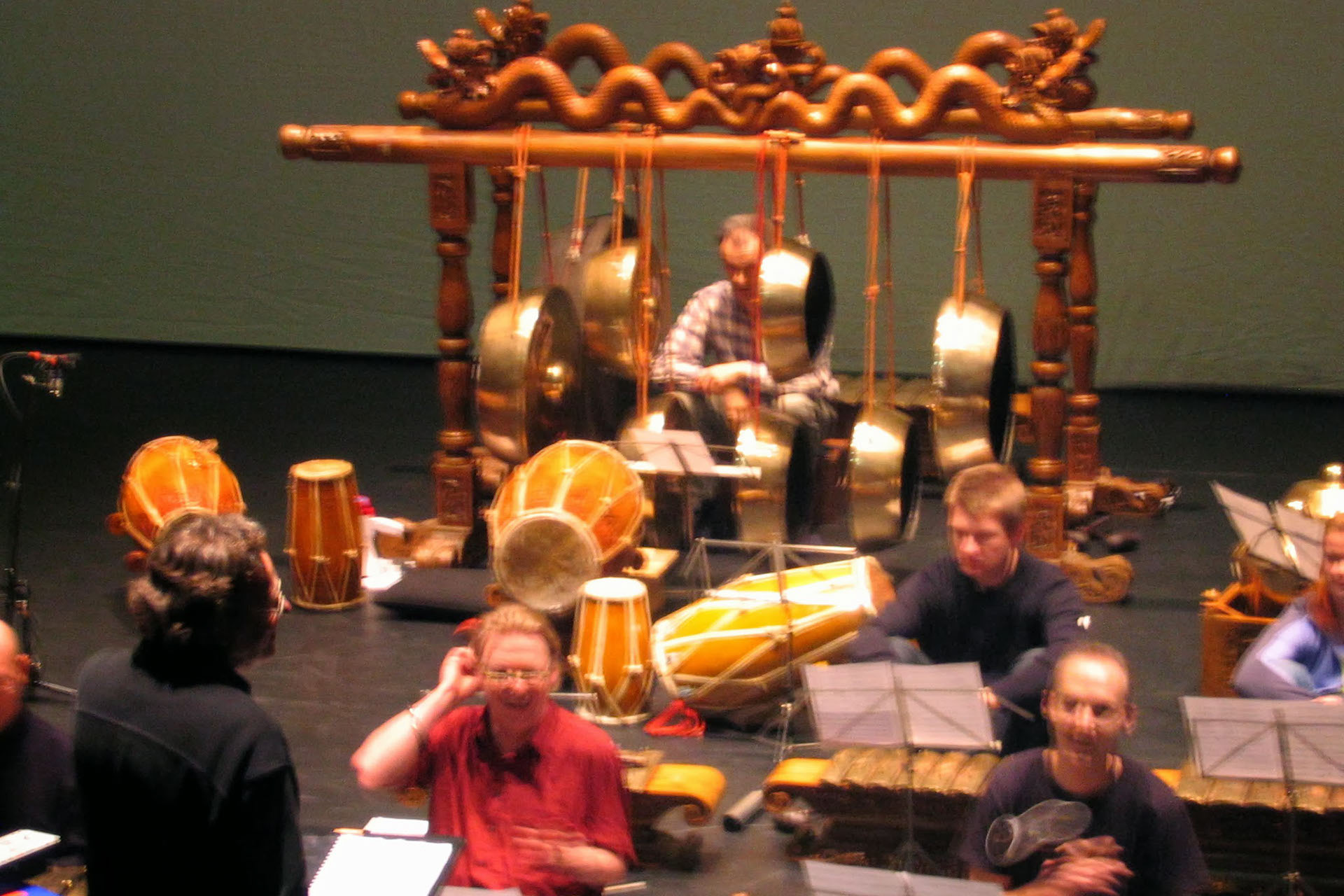
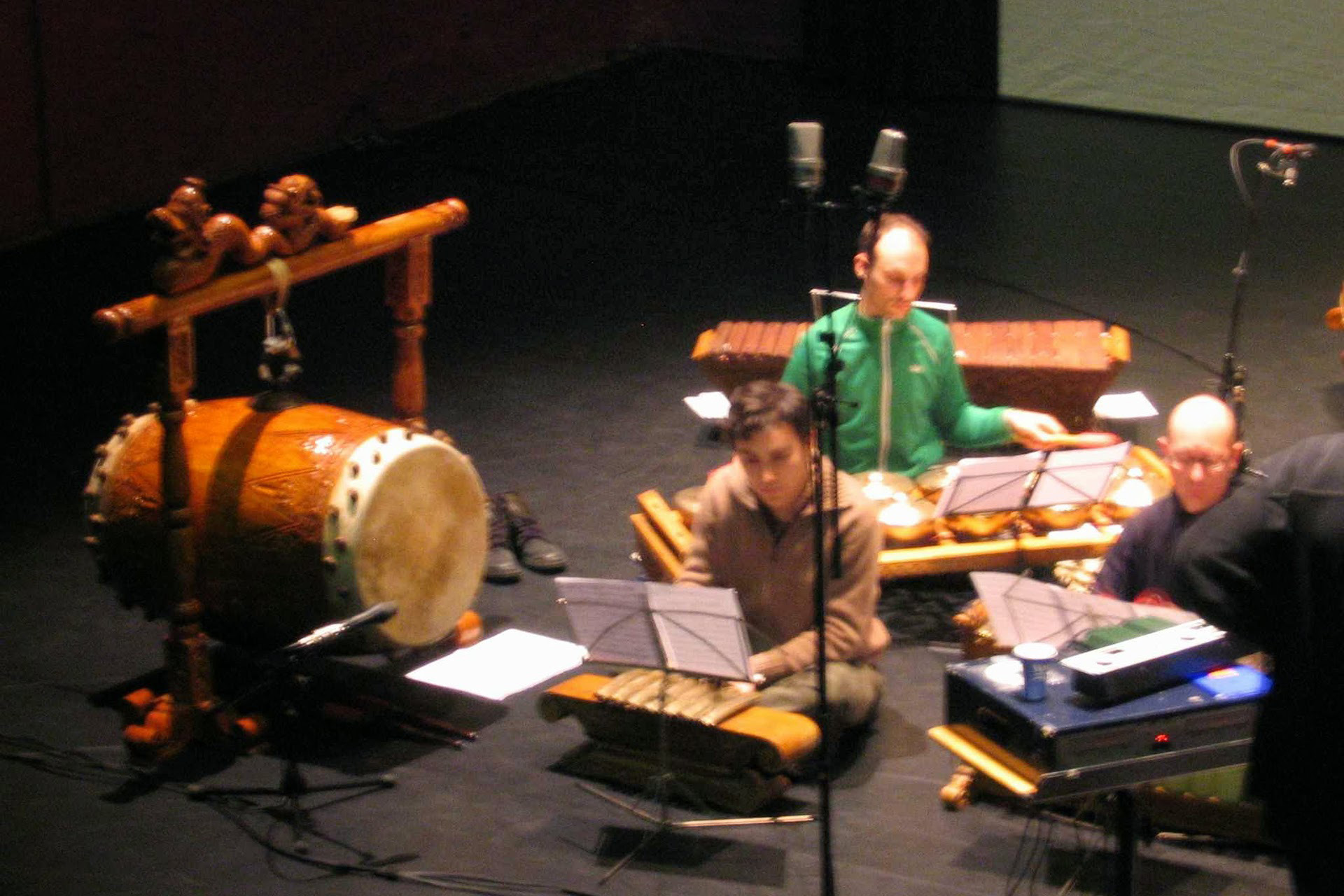
Ensemble Gending was founded in 1989 with a mission to play newly composed music on a Javanese gamelan. This ancient instrument, with its rich bronze sound palette, offers surprising possibilities for contemporary composers. Through Ensemble Gending’s focus on innovation and creative development, over forty compositions for the ensemble have been written in more than 20 years. The ensemble has also initiated several interesting musical experiments, challenging composers to discover new possibilities for both Eastern and Western instruments through the combination of gamelan with other sound sources. For example, the ensemble has played programs where gamelan was combined with electronic soundtracks, Western percussion, vocal ensembles, brass instruments, and bamboo organs. The gamelan is not only a collection of percussion instruments but also inevitably brings composers, percussionists, and listeners into contact with the underlying culture. Since 2006, the ensemble has focused on deepening this cultural dimension by working closely with Indonesian composers and musicians and sharing the results with the widest possible audience in Europe and Indonesia.
Ensemble Gending is opgericht in 1989 met de missie nieuw gecomponeerde muziek te spelen op een Javaanse gamelan. Dit eeuwenoude instrumentarium met zijn rijke bronzen klankpalet biedt verrassende mogelijkheden voor hedendaagse componisten.
VERNIEUWING
Door de op vernieuwing en creatieve ontwikkeling gerichte instelling van Ensemble Gending zijn in ruim 20 jaar meer dan veertig composities voor het ensemble geschreven. Daarbij zijn op initiatief van het ensemble een aantal boeiende muzikale experimenten gerealiseerd. Door de gamelan te combineren met andere klankbronnen worden componisten uitgedaagd nieuwe mogelijkheden te ontdekken van zowel het oosterse als het westerse instrumentarium. Zo heeft het ensemble onder andere programma’s gespeeld waarbij de gamelan werd gecombineerd met elektronische klanksporen, met westers slagwerk, met vocaal ensemble, met koperblazers en met bamboe-orgel.
INDONESISCHE CULTUUR
De gamelan is niet alleen een verzameling slagwerk instrumenten, maar brengt componisten, slagwerkers en toehoorders ook onvermijdelijk in contact met de achterliggende cultuur. Sinds 2006 legt het ensemble zich er op toe deze culturele dimensie te verdiepen door ook nauw met Indonesische componisten en musici samen te werken en de resultaten te laten horen aan een zo groot mogelijk publiek in Europa én Indonesië.