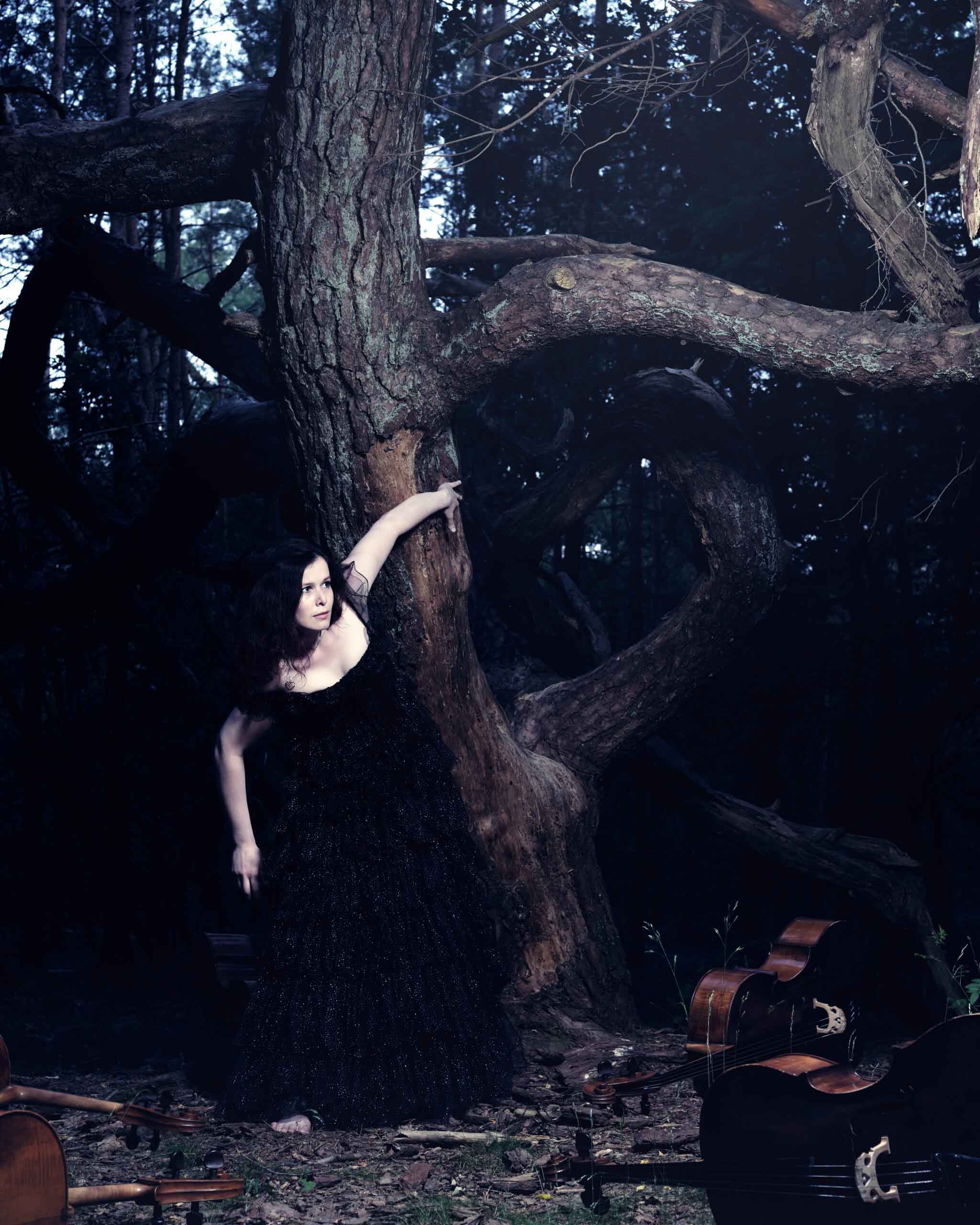
Philemon Mukarno: A New Work of Sound for Cello and Voice
A Piece Written on a Body
There are compositions written for an instrument.
There are compositions written for a performer.
And then there are rare works written for a body – for the way someone breathes, moves, trembles, and dares.
Philemon Mukarno’s new work for cello and voice belongs to this final, most intimate category.
Dedicated to and requested by the phenomenal Maya Fridman, this 40-minute tour de force is not just a duet between two instruments; it is a ritual of unification.
Maya Fridman is not a cellist who simply plays the cello; she inhabits it.
She is not a vocalist who simply sings; she channels sound.
In Mukarno, she has found a composer who understands this totality.
He does not ask her to switch hats – now cellist, now singer.
He asks her to be a single, sounding organism.
This collaboration, supported by the Performing Arts Fund NL, represents a collision of two uncompromising artistic spirits.
It promises to be a defining moment in contemporary solo repertoire.
The Architect Meets the Shaman
To understand the magnitude of this work, one must understand the forces at play.
Philemon Mukarno is a sonic architect.
He builds monoliths.
His music is characterized by a “strong economy of Means” and a “strict control of Form.”
He carves structures out of silence and noise that feel as solid as concrete, yet as mysterious as an ancient temple.
Maya Fridman, conversely, is a musical shaman.
Her performances are known for their “fiery” intensity and deep emotional resonance.
She brings a “cinematic” and “evocative” quality to everything she touches, often blurring the lines between classical precision and ritualistic performance.
When the Architect meets the Shaman, something unique happens.
The rigid structures of Mukarno’s composition become the vessel for Fridman’s spiritual energy.
The result is a work that is “wild, yet controlled.”
It is a container for fire.
Uncompromising Aesthetics: The Grain of the Voice
A defining feature of Mukarno’s style is his preference for “rough, unpolished sounds.”
He is not interested in the polite, bel canto voice.
He wants the grain.
He wants the friction.
In this new work, Maya Fridman’s voice will not float above the cello; it will emerge from it.
Mukarno treats the voice as another string, another texture.
It might growl like a C-string or scream like a harmonic.
The “uncompromising nature” of his writing ensures that this will not be a pretty song with accompaniment.
It will be a visceral exploration of the physical act of sound production.
We can expect the voice to be used as a “sound texture,” similar to how Janneke van der Putten used her voice in Mukarno’s Surat-Surat Perang.
However, where Surat-Surat Perang used electronics to extend the voice, here the cello acts as the second skin.
The wooden body of the instrument and the flesh body of the performer will vibrate in sympathy.
A Duration of Endurance
Forty minutes.
In the world of solo performance, this is a marathon.
Most solo pieces are brief sketches or virtuoso displays.
Mukarno, however, thinks in large-scale forms.
His violin solo Outline lasts an hour; his Surat-Surat Perang is twenty minutes of intense focus.
A forty-minute duration for a solo performer (using both voice and cello) is an act of endurance.
It demands a “monolithic aura” that can sustain the listener’s attention over a long arc.
This is not a collection of short movements.
It is a single, immersive experience.
Mukarno forces the listener to slow down.
He forces us to enter his time.
In a world of fast food content, this demand for time is a radical act.
It is an invitation to deep listening.
It suggests that the piece is not just entertainment, but a “ritual” of transformation.
The Legacy of “Solo”
This work fits into a lineage of Mukarno’s fascination with the solitary performer.
He has written for solo violin (Outline, Wunder), solo carillon (Kathara), and solo voice (Surat-Surat Perang).
In each case, he strips away the safety net of the ensemble.
The soloist is left alone on stage, exposed and vulnerable.
But in this vulnerability, there is power.
The soloist becomes a “demigod,” engaging in a personal apotheosis.
Maya Fridman, with her ability to command a stage, is the perfect protagonist for this drama.
She represents the individual struggling against the silence.
She creates a world out of nothing but wood, string, and breath.
The Performing Arts Fund NL: A Vote of Confidence
The support of the Performing Arts Fund NL is significant.
It validates the importance of this collaboration.
It recognizes that Mukarno and Fridman are pushing the boundaries of what is possible in Dutch contemporary music.
This is not a safe bet; it is an investment in the avant-garde.
It allows Mukarno the freedom to write without commercial constraints.
He does not have to worry about radio play or “easy listening.”
He can be “utterly uncompromising.”
He can write the truth.
The Texture of Truth
What does this truth sound like?
Based on Mukarno’s previous work, we can make some predictions.
It will sound “rough.”
It will sound “industrial” yet “organic.”
It will have moments of terrifying density and moments of shocking silence.
The cello will likely be pushed to its limits—percussive strikes on the body, overpressure on the strings, microtonal slides.
The voice will move from whispers to screams, from intelligible text to pure phonemes.
Together, they will create a “bizarre timbre quality” that sounds like neither a cello nor a singer, but something entirely new.
It will be a sound that is “immediately recognizable” as Mukarno.
A sound that cuts through the noise.
A sound that matters.
Conclusion: A Sonic Monolith
Philemon Mukarno’s new composition for Maya Fridman is more than just a new entry in the cello repertoire.
It is a statement.
It declares that the solo performer is a force of nature.
It declares that the human body and the wooden instrument are one.
It declares that music can still be dangerous, heavy, and profound.
When Maya Fridman takes the stage to premiere this work, she will not just be playing a piece.
She will be stepping into a monolith.
And we, the listeners, will be invited to step in with her.
Meta Title: Philemon Mukarno & Maya Fridman: New Cello/Voice Work
Meta Description: Discover Philemon Mukarno’s new 40-minute work for cello and voice, dedicated to Maya Fridman. An uncompromising ritual of sound.
For cello and voice
Duration: 40 min
Composed with the financial support by the Performing Arts Fund NL
Composed on request of and dedicated to