Small Ensemble
Philemon Mukarno Small Ensemble: Uncompromising Sonic Intimacy
The Power of Condensed Sound
Philemon Mukarno creates music that defies the expected boundaries of scale. His work for small ensembles proves that intensity does not require mass. Even with fewer instruments, he builds sonic monuments that feel vast and heavy. This is not “chamber music” in the polite, traditional sense. It is a concentrated dose of his uncompromising artistic vision. Every instrument is pushed to its physical and expressive limit. There is no place to hide in these sparse textures. Consequently, the listener encounters the raw essence of Mukarno’s aesthetic. It is a world where silence is as heavy as granite.
A Rejection of Irony
In a contemporary scene often filled with intellectual games, Mukarno stands apart. He rejects the safety of irony and pastiche completely. His small ensemble works are terrifyingly sincere. They demand that you take them at face value, without distance. This “lack of distance” creates a unique, almost uncomfortable intimacy. You feel the physical presence of the players and their struggle. The music does not comment on itself; it simply is. This total belief in the work gives it a ritualistic power. It compels the audience to surrender to the immediate reality of the sound.
Eluney: The Architecture of Overtones
Consider his string quartet, Eluney (2013), commissioned by the Performing Arts Fund. Here, Mukarno deconstructs the traditional string quartet sound. He avoids the cliché of melodic development or predictable harmonies. Instead, he focuses on the spectral interior of the sound itself. The piece makes extensive use of natural harmonics and overtones. These ghostly, high-frequency sounds float above the gritty texture of bowed strings. It is inspired by the Tucumán concept of “Gift of God”. Yet, the music is not sentimental; it is elemental and raw.
Sculpting with Silence
Silence in Mukarno’s small ensemble music is a weapon. It is not merely a pause between notes. It is a solid block of time that holds immense tension. In works like Iyona (Jonas), silence frames the transformation of timbre. The listener is forced to wait, to breathe, and to remember. This use of negative space creates a sculptural quality in the music. You can almost walk around the sounds as if they were statues. It highlights his strict control of form and economy of means. Nothing is wasted; every second is calculated for maximum impact.
Unorthodox Sonic Alliances
Mukarno rarely chooses standard instrument combinations for his small ensembles. He prefers to clash disparate timbres against one another. Take Farah (2008), for example. It is scored for accordion, bass clarinet, and trombone. This strange trio creates a thick, reedy, breathing texture. The accordion’s wheeze blends with the growl of the bass clarinet. The trombone adds a metallic, vocal quality to the mix. These instruments do not blend in a traditional sense. They struggle and interact, creating a friction that drives the piece forward.
The Electronic “Skin”
Electronics often play a crucial role in expanding the small ensemble palette. In Gynoids XX (1999) for two pianos and electronics, the digital realm invades the acoustic. The electronics are not just background effects or ambiance. They act as a third, invisible partner in the dialogue. They extend the piano’s decay into impossible durations. Often, they provide a rough, unpolished noise layer that contrasts with the acoustic precision. This interplay creates a “voice-skin”—a digital texture that wraps around the live instruments. It blurs the line between human and machine performance.
Ameleth: A Study in Registers
In Ameleth (2004), Mukarno explores the extreme registers of wind instruments. The piece utilizes contrabass clarinet and baritone saxophone alongside their higher counterparts. This focus on the low end creates a subterranean rumble. It shakes the floor and resonates in the listener’s chest. The piano acts as a percussion instrument, hammering out skeletal rhythms. The contrast between the guttural lows and piercing highs is visceral. It feels like a conversation between giants in a small room. The sheer physical weight of the sound is undeniable.
Surat-Surat Perang: Intimate Warfare
The work Surat-Surat Perang (2020) showcases Mukarno’s approach to the human voice. Scored for voice and “voice-skin” (electronics), it is a duet of intense intimacy. The piece explores the boundaries of vocal interaction. The electronics multiply and distort the singer’s voice in real-time. It creates a hall of mirrors where identity becomes fluid. The title, translating to “War Letters”, suggests conflict and struggle. Yet, the conflict is internal, fought within the grain of the voice itself. It is a haunting exploration of communication and isolation.
The Influence of Ritual
Although these works use Western instruments, the shadow of the Gamelan remains. It appears not in the melodies, but in the perception of time. Mukarno’s small ensemble works often progress with a ritualistic slowness. Events unfold with the inevitability of a natural process. The “Economy of Means” he is famous for mirrors the efficiency of traditional rituals. There is no decoration, only essential action. This gives pieces like Zia (for two toy pianos) a surprisingly grave demeanor. Even with toy instruments, the intent remains serious and monolithic.
Visualizing the Invisible
Listening to these works is an inherently visual experience. The textures are so tactile they evoke physical materials. You hear wood cracking, metal groaning, and air rushing. The music conjures images of industrial ruins or ancient, overgrown temples. Mukarno paints with timbre, using sound to occupy physical space. This quality makes his work ideal for multimedia and dance collaborations. However, even as pure audio, it stimulates the inner eye. It forces the listener to construct a visual world to match the sonic one.
A Challenge to the Performer
Playing Mukarno’s small ensemble music is an athletic feat. It requires absolute precision and unwavering focus. The musicians cannot rely on conventional expressive tropes. They must execute complex rhythms and extended techniques with total conviction. Furthermore, they must maintain the intense tension of the silences. It is a physical workout as much as a mental one. This demand for total commitment translates directly to the audience. We feel the strain and the triumph of the performance.
The “Rough” Aesthetic
Critics often note the “rough, unpolished” quality of Mukarno’s sounds. This is a deliberate aesthetic choice. He prefers the grain of the sound to a polished sheen. He wants to hear the friction of the bow and the breath of the player. This roughness connects the music to the earth. It prevents the work from becoming too abstract or academic. It keeps the music grounded in the physical reality of its production. It is a reminder that sound is generated by human effort and friction.
Conclusion: A Singular Voice
Philemon Mukarno’s small ensemble works are gems of high-pressure creativity. They compress his vast, monolithic vision into a diamond-hard intensity. They challenge our expectations of what chamber music can be. By rejecting irony and embracing a rough, tactile aesthetic, he creates a unique world. It is a world of deep seriousness and profound sonic beauty. Ultimately, these works stand as testaments to an artist who follows only his own path.
Meta Title: Philemon Mukarno Small Ensemble: Uncompromising Sonic Intimacy
Meta Description: Discover Philemon Mukarno’s small ensemble works. Explore his uncompromising style, from the string quartet Eluney to the electronic textures of Gynoids XX.
String quartet
Composed for DoelenKwartet
Commissioned by Fonds Podiumkunsten
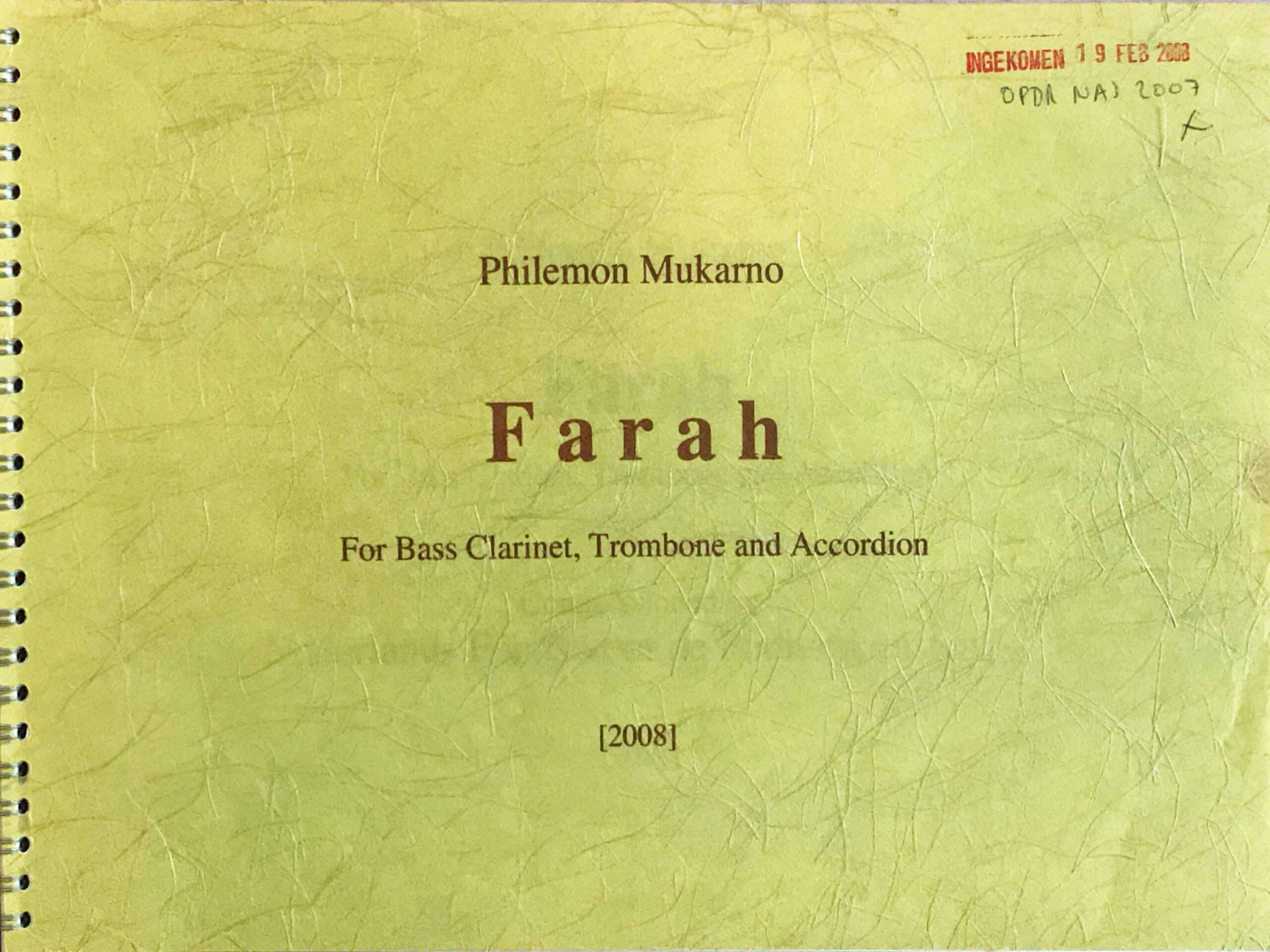
For accordion, bass clarinet and trombone.
Commissioned by Nederlands Fonds voor de Podiumkunsten +
For soprano saxophone, cello, percussion, harpsichord and electronics.
Commissioned by Fonds voor de Scheppende Toonkunst
For clarinets (Bb clarinet and contrabass clarinet), sax (alto sax and baritone sax) and piano.
Commissioned by the Flemish Government
For clarinets (Bb clarinet and contrabass clarinet), sax (alto sax and baritone sax) and piano.
Commissioned by the Flemish Government
For accordion, bass clarinet, trombone, piano and electronics
Commissioned by Filmmuseum/Filmbank
Eva & Harlot (2005) ’20
For violin, soprano, percussion, recorder/ocarina and electronics.
Commissioned by Fonds voor de Scheppende Toonkunst
Demam (2001) ’30
For gamelan and electronics
Commissioned by Stichting Pasar Malam Besar
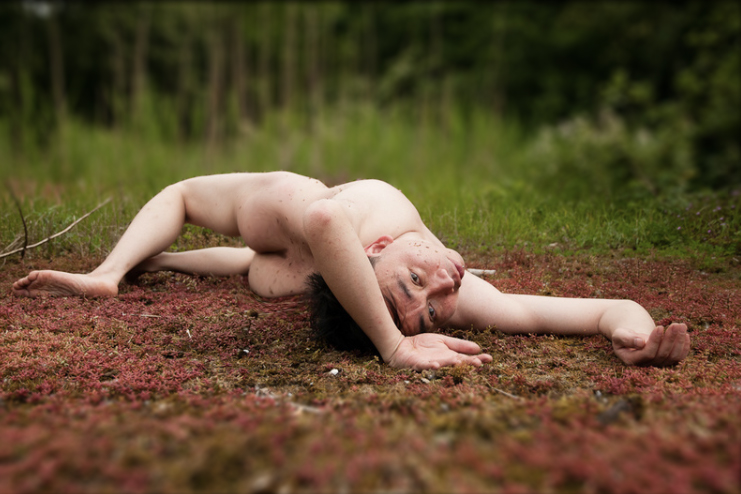
Elia Demostra (2002) ’20
For church organ, carillon and live electronics.
Commissioned by Amsterdams Fonds voor de Kunst.